
Understanding the conformations of amino acids is a deciding factor when predicting the interactions between a protein and the ligand. The misidentification of such interactions might produce false computation results due to inaccurate models. Consequently, constructing the robust library of rotational isomers, also known as rotamers, is a key factor in predicting the consequences of a point mutation in a protein, binding energies with a designed molecule or protein surface.
Various rotamer libraries that differ both in strategies and quantity or quality of initial data has been developed. Most of the widely used libraries are generated first by carefully selecting high-resolution protein structures from Protein Data Bank archive (PDB), then grouping amino acids by their type and calculating the frequency of the most occurring dihedral angles in that group [1]. Depending on the library, groups can be further divided by structure of the main chain atom, solvent accessibility or other criteria [2].
Using general pre-calculated libraries is very favourable, because it requires almost no computational-time when determining correct conformations. However, libraries are dependent on the initial structures and lack both diversity of side-chain rotamers and the interaction with surrounding atoms [1].
In this study, we are developing the program that generates the rotamer library that can be constructed using only the structure of the investigated protein. The core principle of the approach is a limited movement of side-chains imposed by the fixed number of degrees of freedom (Fig.1). A position of the side-chain atom can vary due to the bond torsion, stretching and angle bending.
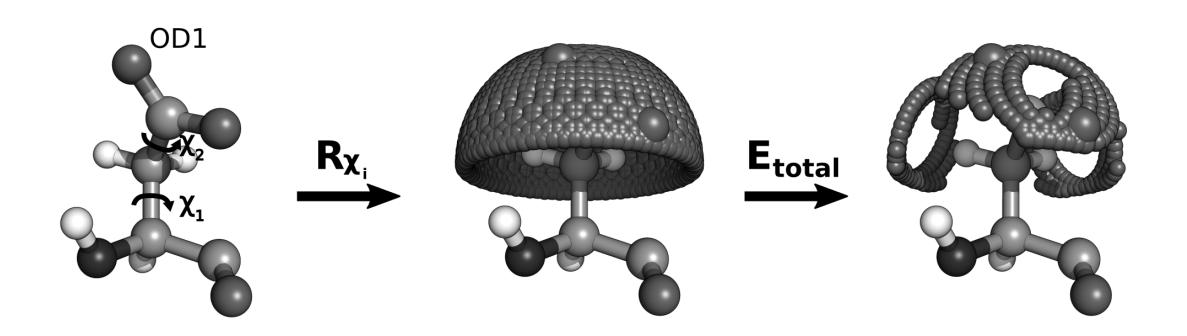
The dihedral angle was chosen as the variable for constructing a simple rotamer model, because rotation around the bond produces the most extreme changes on the positions of atoms. The possible atom position of the specific side-chain is determined by first changing the dihedral angles for all bonds. It can be achieved by using matrix multiplication of the rotation matrices:
$$p^{0'} = T_n^0 (\prod_{i=1}^n R_{\chi_i} T_{i-1}^i) p^0\tag{1}$$where $p$ is the vector describing the position of the atom, $T$ - the transformation matrix for changing the frame of reference and $R$ - the rotation matrix. Matrix multiplication is calculated analytically for greater computational efficiency.
Then potential energy of each side-chain atom is calculated and high-energy rotamers are excluded (2). Combinatorial explosion is avoided by using dead-end elimination and cell-list neighbour search while calculating potential energy. The bond stretching and angle bending are planned to be included in the model in the future.
$$E_{total} = \sum_{i}^{n} E_{Leonard-Jones} + E_{Coulomb} + E_{H-bond}\tag{2}$$Building such dynamic library could increase likelihood of detecting rare rotamers and reveal broader picture on the impact of side-chain positions.