Aluminum (Al) is a promising material for applications in plasmonics. Nowadays, SERS substrates based on plasmonic Al have primarily focused on nanostructures fabricated using e-beam lithography, such as nanoparticle or nanohole arrays and bowtie structures, along with roughened films and gratings [1, 2].
This work shows the investigation of microcrystals of lead (II) oxide (PbO) and lead (II) chromate (PbCrO4) by SERS. The samples were prepared as the thin layers on the glass and aluminum foil. The size of microcrystals is about 10 μm. Raman scattering (RS) spectra were registered by spectrometer NanoFlex (Solar LS, Belarus) with Ar+ laser (488 nm). Raman spectra exposure time was 60 s.
Aluminum foil is charecterized by roughnesses with height about 150-200 nm and diameter from 1 to 10 μm. Reflectance spectrum of Al foil has peaks at 615 and 670 nm.
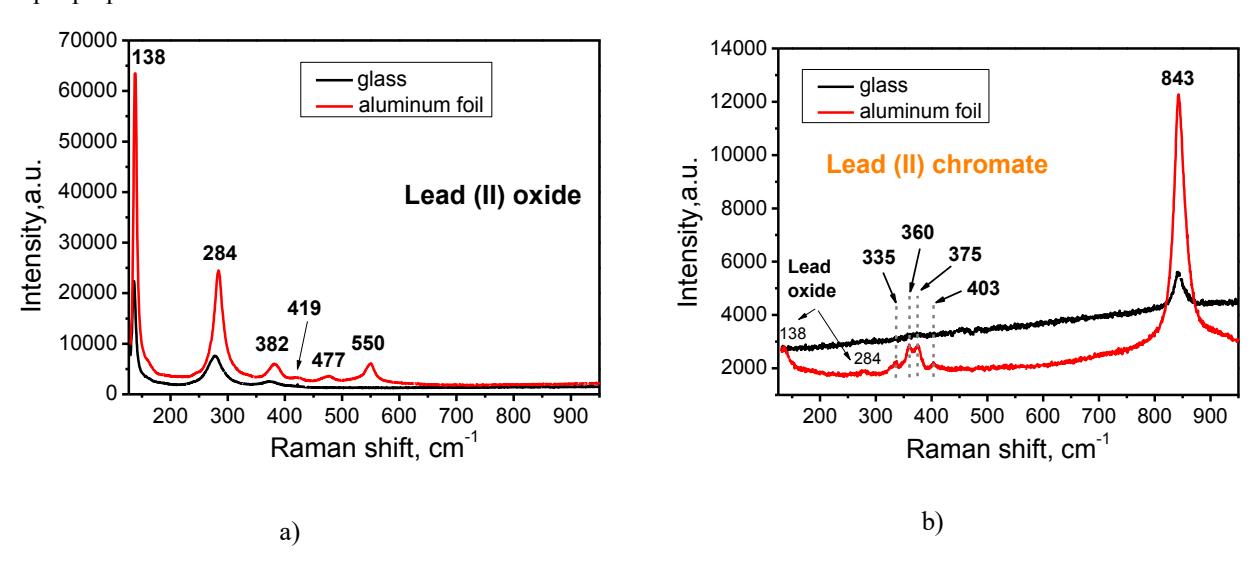
Raman spectrum of PbO (Fig.1a) has bands at 138, 284, 382 and 419 cm-1. SERS spectrum of lead (II) oxide is characterized by enhancement of intensity of the bands at 138 cm-1 and 284 cm-1 on 1 order of magnitude. Also SERS spectrum has new bands at 477 and 550 cm-1 corresponding to α-PbO [3].
Raman spectrum of PbCrO4 on the glass (Fig.1b) has a peak at 843 cm-1. The using Al foil gives Raman scattering enhancement of this peak up to 8 times. In the case of lead (II) chromate adsorbed on Al foil the new bands at 335, 360, 375 and 403 cm-1 appear. The obtained spectra are characterized with a high signal-to-noise ratio and low luminescence background.
Thus we conclude, the using Al foil allow to essentialy increase the sensitivity of RS for microcrystals study and could be a promising substitute for gold (Au) and silver (Ag) in plasmonics research due to its lower cost and simplicity of sample preparation.