
Since few years, nanoporous materials are of great interest for various applications including sensors based on surface-enhanced Raman scattering, catalysis, and biotechnology. Currently, tremendous efforts are dedicated to the development of nanoporous nanowires materials [1]. A new strategy to prepare highly ordered ultralong porous gold nanowires with a tunable porosity was recently reported [1]. This two-step approach is based on the growth of Au-Cu alloy nanowires by magnetron sputtering over a nanograted substrate serving as a physical template followed by electrochemical dealloying allowing creation of nanoporous nanowires [1].
In order to explain the great plasmonic properties of nanoporous material, study of plasmonic effects in porous and nonporous Au nanowires was performed by means of transient absorption spectroscopy (TAS). The samples were excited at 435 nm, the power of excitation was 2 mW, frequency of pulses was 200/3 kHz. The signal of TAS was registered not in the casual transparent mode but in the reflection one. The TAS setup was arranged that reflection angle from the sample would be as small as possible because reflection angle may have the additional impact on TAS signal. The grating template used determines the geometry of the nanowires studied and as one can see (Fig. 1a and 1b) the neighboring lines with subwavelength spacing are parallel. This fact is very important owing polarization dependent TAS signal. The polarization of pump and probe pulses used for the TAS measurements were parallel, perpendicular or mixed with respect to the alignment of porous and nonporous Au nanowires.
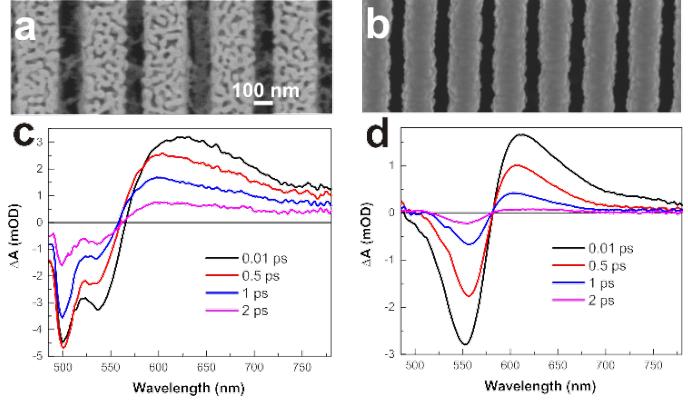
There is a clear difference in TAS signal between the porous and nonporous Au nanowires (Fig 1c and 1d). TAS signal (spectra and traces) shows that localized surface plasmon resonance (LSPR) was excited during the measurements. We suggest that TAS signal appears because of LSPR in nanoparticles [2,3], i.e. because of the nanometric width of the gold lines where transversal LSPR mode is excited.
The LSPR relaxation typically consists of several steps: electron-electron (e-e) scattering, electron-phonon (e-p) coupling and phonon-phonon (p-p) coupling [3]. In our case, we can presumably observe e-p coupling and p-p coupling. The process of e-e scattering creates hot electrons. The hot electrons during the e-p coupling process transfer their energy to the lattice of Au nanowires and the material heats up during ~1 ps. The hot lattice transfers energy to the environment by p-p coupling that happens during ~100 ps. We can observe both processes like a negative TAS signal.
TAS spectra of nonporous Au nanowires show no evidential dependence on polarization of pump and probe beams while porous Au nanowires show clear dependence.