High-power microwaves (HPM) have a wide range of applications in plasma heating, particle acceleration, high-power radar, and many other industrial and military fields. There are lots different types of HPM sources: klystron amplifiers, backward wave oscillators (BWO), travelling wave tubes (TWT), transit-time oscillator (TTO), virtual cathode oscillator (vircator), etc. Despite the great success in their development, their use is often limited by large size or low efficiency. For this reason Barry M. Marder with his group developed new device, called split-cavity oscillator (SCO) [1, 2], which was improved by others scientists [3, 4]. SCO does not require external magnetic guide field, therefore has a smaller size then BWO or TWT, and has a larger efficiency then TTO or vircator. SCO consists of a cylindrical resonator with a conducting screen walls splitted by a conducting screen (Fig.1) which an electron beam can pass. This configuration has additional fundamental electromagnetic modes (see Fig. 1) in comparison with a hollow resonator.
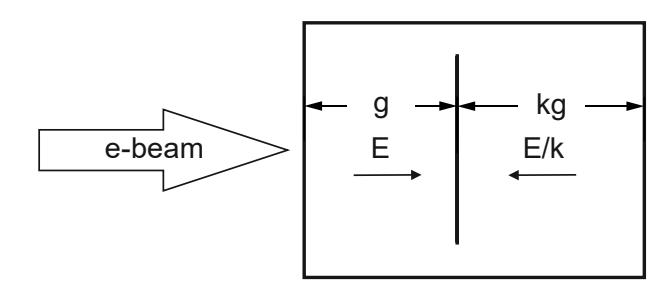
The research is devoted to theoretical and experimental research of HPM source based on the SCO. Interaction between electron beam and fundamental mode was considered. Expressions of a beam-energy change were obtained 1) for an asymmetric resonator taking into account the space charge of beam and 2) for relativistic beam. The small-signal analysis showed that the optimal configuration is symmetric, the space charge almost does not effect on the resonator size, increasing of electron velocity decreases energy transfer efficiency to electromagnetic field.
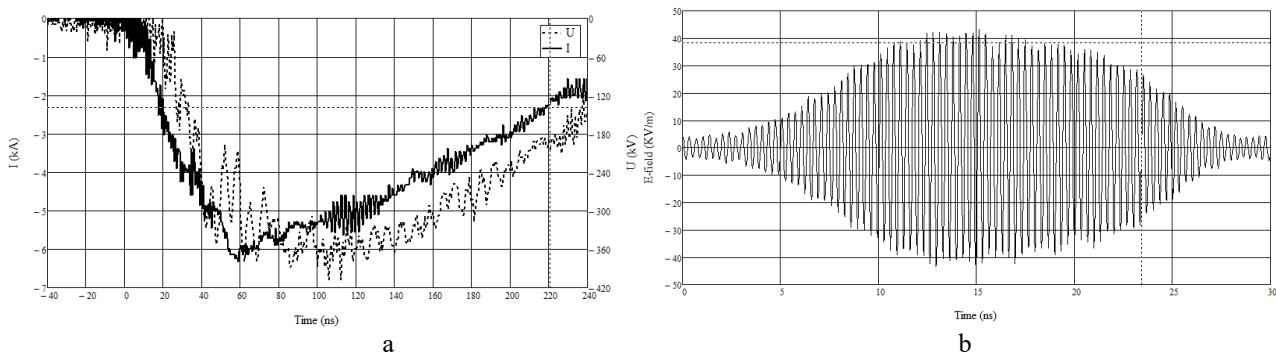
Experimental research confirmed theoretical predictions. HPM generation was obtained on the calculated frequency (Fig.2). Method of tuning frequency was developed and HPM radiation was detected in range of 2.5-3 GHz.