
Analysis and prediction of the absorption spectra of organic and inorganic molecules in the visible and ultraviolet regions are important theoretical and practical tasks. Nowadays, the most widely applied method for calculating the electronic structure and modeling the electronic spectra of polyatomic molecules is Time-Dependent Density Functional Theory (TDDFT). It is a well-known fact that the frequently used functionals in the TDDFT calculations of excited state energies gives a large deviation in comparison with the experimental values (up to 0.4 eV). It is also noticeable that TDDFT calculations are unsuccessful in the case of intramolecular charge transfer (ICT) excitations. However, there is an alternative to the TDDFT method which is called multi-reference approximation (for example, multi-reference perturbation theory, or MRPT).
The objectives of this study are to evaluate the success of using the above-mentioned approximations for the comprehensive analysis of UV/Vis absorption spectra of widespread organic compounds, most of which are characterized by ICT, as well as, on the basis of the results obtained, to analyze and interpret the UV/Vis spectra of a number of adamantane-containing compounds, perspective for medicinal chemistry and for drugs design. The following compounds are investigated in terms of the first objective: aniline, trans-azobenzene, benzaldehyde, glycine, phenol, phenyl isocyanate, pyridine, pyrimidine. We have altered these ones due to available experimental data, it is also known about the ICT for mentioned molecules and they are widely used in biological and chemical industry.
We carry out calculations of spectral and energetic characteristics of the excited singlet electronic states for the above mentioned compounds at the TDDFT approximation using the hybrid CAM-B3LYP functional and perform the ab initio calculations at the multi-reference perturbation theory CASSCF/XMCQDPT2 approximation. All calculations are carried out using the cc-pVDZ basis set. The influence of solvents was taken into account by the approximation of the Solvation Model Density (SMD) for TDDFT calculations.
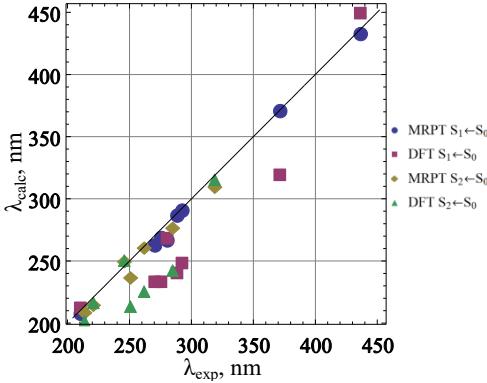
The results of the calculations are shown in Fig. 1. It follows that in most cases TDDFT calculations overestimate energy (underestimate wavelength) of the $S_1 \leftarrow S_0$ и $S_2 \leftarrow S_0$ transitions and the second approximation results a good agreement with the experimental spectra. It is worth mentioning that namely ab initio multi-reference (configuration interaction, perturbation theory) should be recommended for simulations and predictions of the UV/Vis spectra.
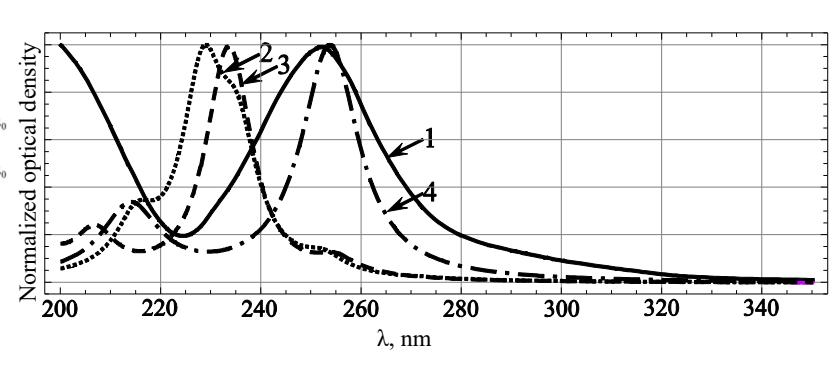
We use the same approximations to interpret the UV/Vis spectra of solution of 5 adamantane-containing compounds in ethanol: N'-(adamantan-2-ylidene)benzohydrazide (I), (3-(adamantan-1-yl)-1-[(4-benzylpiperazin-1-yl)methyl]-4-phenyl-1H-1,2,4-triazole-5(4H)-thione (II), 3-(adamantan-1-yl)-4-phenyl-1-[(4-phenylpiperazin-1-yl)methyl]-1H-1,2,4-triazole-5(4H)-thione (III), 3-(adamantan-1-yl)-4-ethyl-1-[(4-phenyl-piperazine-1-yl)methyl]-1H-1,2,4-triazole-5(4H)-thione (IV), ethyl-4-{[3-(adamantan-1-yl)-4-phenyl-5-sulfanylidene-4,5-dihydro-1H-1,2,4-triazol-1-yl]methyl}piperazine-1-carboxylate (V). The results of calculations for one of these compounds (IV) are shown in Fig. 2. Here one can see that TDDFT approximation predicts zeroth intensity for the $S_1 - S_0$ transition with overestimated wavelength and this band has been short-wavelength shifted when one takes into account the solution model. We assume that the errors in the TDDFT calculations are due to the possibility of the ICT. At the same time the results of the multi-reference perturbation theory calculations are in good agreement with the experimental data.