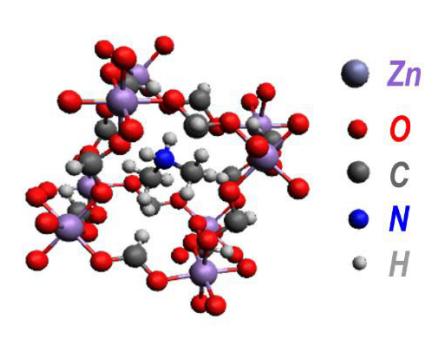
We employ electron paramagnetic resonance (EPR) spectroscopy to study the structural phase transition in irradiated dimethylammonium zinc formate [(CH3)2NH2][Zn(HCOO)3] (DMAZn), which is considered as a dense metal-organic framework (MOF). This hybrid compound is based on the perovskite AMX3-type (where A = (CH3)2NH2+, M = Zn2+, X = HCOO-) topology, where the cuboid cavity is occupied by a DMA+ molecular ion (Fig. 1). The DMA+ cation is disordered over three positions at $T > T_c$. Here $T_c$ is the temperature of the phase transition. The DMA+ becomes ordered in one of the three positions below $T_c$ and, as a result, the whole MOF undergoes a structural phase transition when cooled to $T_c \sim 160$ K. We irradiated [(CH3)2NH2][Zn(HCOO)3] crystals using 30 keV X-ray source in order to create paramagnetic centers that are necessary for the EPR measurements. The continuous-wave (CW) EPR measurements were performed at X-band microwave frequency using a conventional Bruker E580 EPR spectrometer. After irradiation, we observed an EPR line of a free radical with g-factor equal to 2.02. We examined temperature dependence and determined how spin Hamiltonian parameters of the radical change at the phase transition point.