Metal-organic frameworks (MOFs) are the novel type of porous materal, that have recently emerged and attracted attention of the scientific community [1,2]. These crystalline compounds are unique due to the high degree of porosity which can be utilized for gas adsorption related applications [3]. Additionally, many MOFs containing paramagnetic transition-metal ions exhibit peculiar magnetic properties. The organic part in several of such compounds consists of polar molecules which below a certain phase transition temperature order into a ferroelectric-type phase, making these materials single-phase hybrid multiferroics[4].
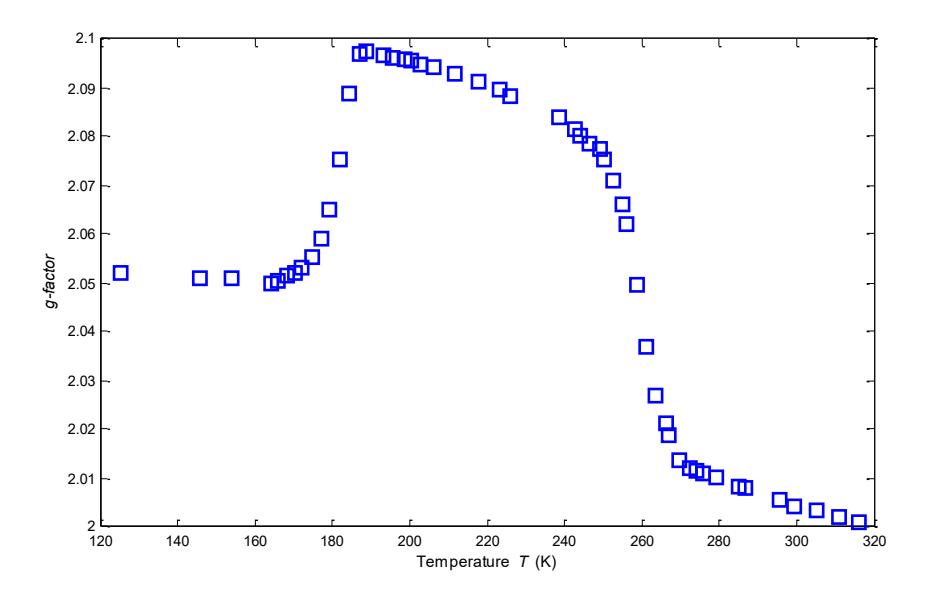
Here we present a continuous-wave electron paramagnetic resonance (CW EPR) study of two such hybrid compounds based on the perovskite topology, $[(\text{CH}_3)_2\text{NH}_2][\text{KCr}(\text{CN})_6]$ and $[(\text{CH}_3)_3\text{NH}][\text{KCr}(\text{CN})_6]$. The EPR experiments are performed at the X-band frequency ($\approx$9.5 GHz) on powdered MOF samples in a wide temperature range while cooling. The obtained results indicate that the compound containing trimethylammonium organic cations undergoes two structural phase transitions at $T_{c1} = 260$ and $T_{c2} = 183$ K (Fig. 1). A single phase transition at 206 K is observed for the dimethylammonium MOF. These anomalies may be related to the changes of the chromium(III) relaxation times.