Ideal Bessel beams belong to a family of optical fields with propagation-invariant transverse intensity distribution (also called non-diffracting beams) [1]. The experimental approximation of these beams exhibits long axial intensity line which is useful for many practical applications e.g. microfabrication [2], particle manipulation [3] etc. Such laser beams with high length to width ratio and flat top are called optical needles. One can choose a complex amplitude for each Bessel beam such that the superposition of these beams obeys any chosen axial longitudinal intensity distribution [4]. Furthermore, usage of vector beams, enables one to control also the polarization and transverse localization. As an exotic example can be longitudinally polarized optical needle [5].
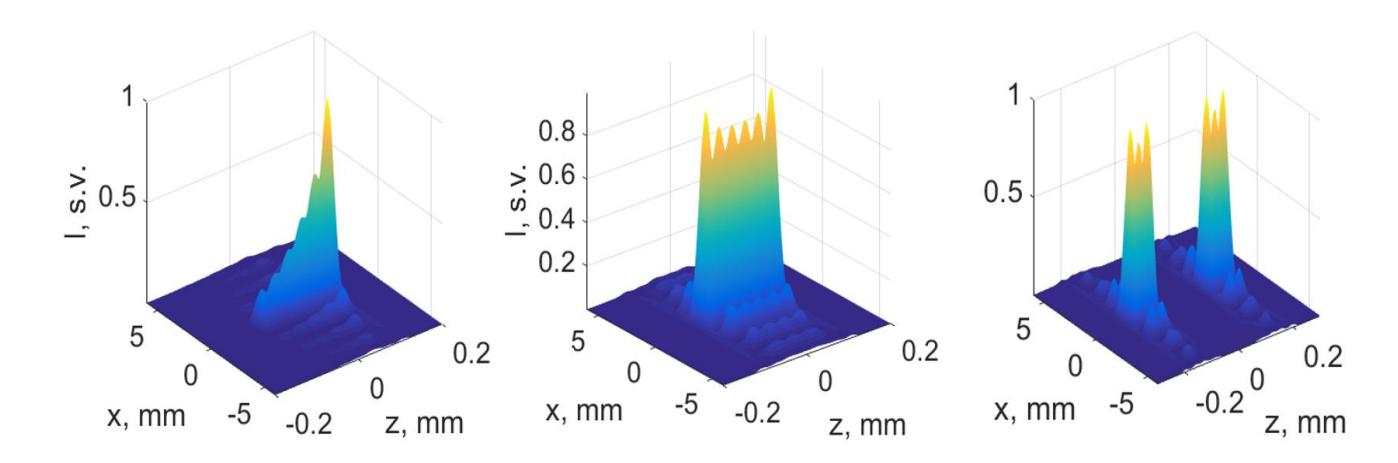
First we define a specific longitudinal intensity pattern and compute the corresponding spatial spectra. Then in order to obtain desired beam shape the complex spectral mask is encoded to phase-only mask and displayed on SLM. We investigate the quality of generated optical needle beams by comparing it to the numerical simulation results. We also analyse the limitations of our experimental setup. An example of modeled three beam longitudinal profiles using superposition of zero-order Bessel beams are shown in Fig. 1.