
Nonlinear spectroscopic methods, that were developed in recent decades, enable to observe and analyze the excitation transfer and relaxation in molecular aggregates. For the description of these systems the theoretical models are needed that could help to discern the origin of these effects. Molecular aggregates are interesting because they exhibit properties of both solid state and single molecule. In these aggregates the optical excitation can spread across several molecules or localize. Excitation dynamics in these objects can be described quite well by Frenkel exciton and Redfield relaxation theories.
In some cases, though, such description can be insufficient, particularly, when the molecular aggregate exhibits a resonant oscillation, when frequency of oscillation is close to energy of electronic levels. The vibronic model enables us to account for these oscillations explicitly. Usually molecular aggregate Hamiltonian is divided into parts: system, bath, and system-bath interaction. Then all oscillations are taken as a part of the bath, and are accounted by assuming that the system-bath interaction is weak and second order perturbation theory is applied in relation to this interaction. Vibronic approach expands this description by including the oscillation into the system Hamiltonian explicitly as a harmonic quantum oscillator. The eigenstates of this system Hamiltonian are vibronic states - the excitations that are spread across electronic and vibrational states.
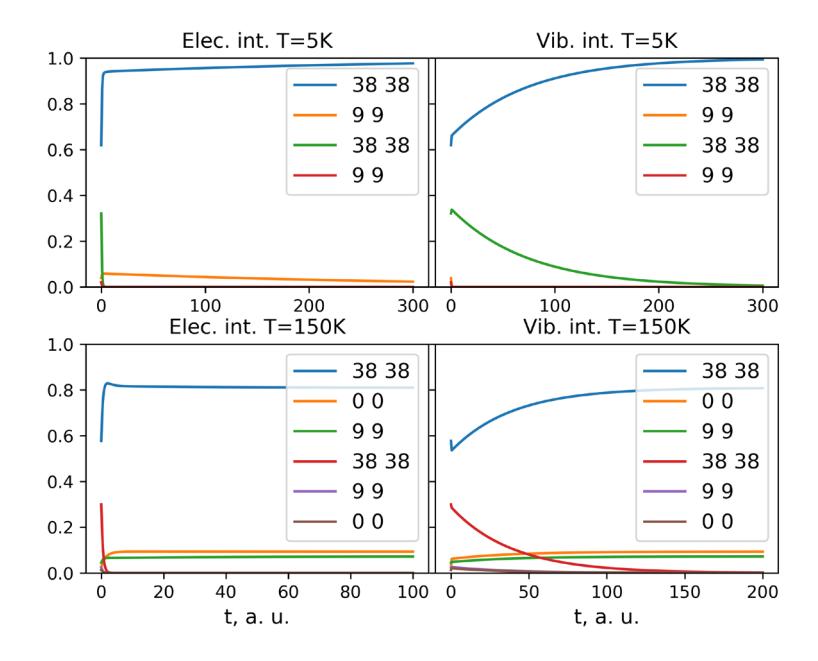
Vibronic model theory was developed in [1]. In this work this model was applied to calculate absorption spectra for molecular dimer with vibronic model for different parameters. Also the relaxation of excited state in vibronic model was analyzed for molecular dimer. These calculations were made for two cases: when there is only electronic or vibrational interaction with bath.
The results show that the vibronic model is most useful in cases, when the energy gap between electronic excitations is similar to a bath oscillator frequency 1, also that there are two modes of excited state population relaxation: fast and slow, when there is only one type of interaction with the bath (electronic or vibrational).