
In search of novel and cost-effective transparent conductive oxide (TCO) materials to replace Sn-doped In2O3 (ITO), alkaline-earth stannate family MSnO3 is being widely investigated. La-doped Barium stannate (BaSnO3) as n-type perovskite semiconductor has been reported to exhibit good visible light transparency and high charge carrier mobility. Unlike common TCO materials barium stannate is perovskite type material and is a good match with various ferroelectric piezoelectric and other active materials. Due its properties BaSnO3 could prove to be a perfect candidate as electrode layer in wide range of applications. In recent years single-phase film deposition has been achieved by physical methods such as Molecular beam epitaxy (MBE)1 or Pulsed laser deposition (PLD)2. The aim of this work was to deposit crystalline single-phase barium stannate thin films by Pulsed injection metal organic chemical vapor deposition (PI-MOCVD) method which allows much easier and wider compositional control. MOCVD is most desirable and widely used technology in mico- and optoelectronics fabrication. Although this type of deposition has so far not been successfully used for the deposition of such materials.
Barium stannate depositions were carried out using solution containing Sn(thd)2 and Ba(thd)2 precursors in dimethoxyethane. Layers were deposited in Ar:O2 (8:2 v/v) atmosphere. Due to low film/substrate lattice mismatch, cubic LaAlO3 was selected as a substrate. Effects of deposition temperature and precursor ratio on thin film were investigated. In order to determine layer composition and morphology Scanning Electron Microscopy (SEM) and Energy Dispersive X-ray Spectroscopy (EDX) were used. Film phase composition and crystal orientation were characterized using X-ray Diffractometry technique.
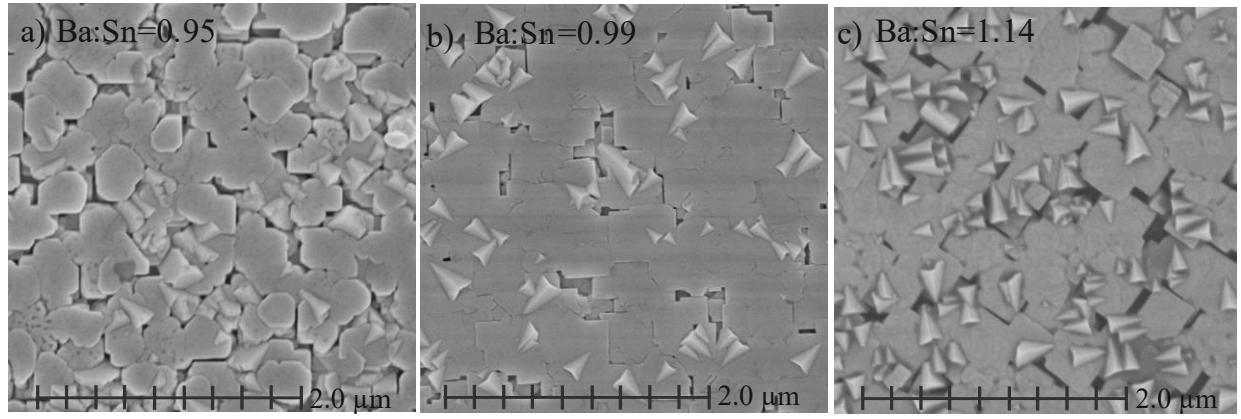
For the first time thin epitaxial barium stannate films (200-250 nm) have been obtained using PI-MOCVD method on LaAlO3 (100) substrates (Fig.1). It was observed that changing precursor ratio in the solution, Ba/Sn ratio of the layer could easily be controlled whilst using 850 °C deposition temperature. To achieve stoichiometric thin films a surplus amount or Ba(thd)2 was necessary. In addition, no other phases were detected even if layer composition slightly deviated from stoichiometric composition. It was also discovered that surface morphology was greatly dependant on precursor ratio, thus allowing us to control and obtain smoother surfaces.