Surface-enhanced Raman scattering (SERS) is a powerful spectroscopic analytical tool of determining structural information for molecules adsorbed on noble metal nanostructures. In addition, noble metal/semiconductor hetero-junctions, which have wide applications in nanoelectronics, optoelectronics, plasmonics, medical diagnostics, catalysis, drug delivery, and chemical sensing, also have shown effective enhancements in Raman scattering and were demonstrated to be appropriate as versatile SERS substrates [1, 2, 3].
This work shows SERS-activity of the novel semiconductor-metal hybrid nanostructures that consists of Si-Ge and Ge coated with Au film.
Three types of Au/Si-Ge and Au/Ge nanostructured substrates were used to obtain SERS spectra of mitoxantrone (M=$10^{-5}$ M). Au/Si-Ge surfaces are characterized by cone-shaped roughnesses (height is 50-150 nm, diameter is 0.5-1 μm). Au/Ge surfaces are characterized by roughnesses of 40-60 nm in height and 1 μm in diameter. Also Au/Ge III surface has some structures with height about 250 nm. The thickness of Au layer is 15 nm. The experiment was conducted with laser excitation at wavelengths λ = 632.8 and 785 nm. Exposure time was 5 s.
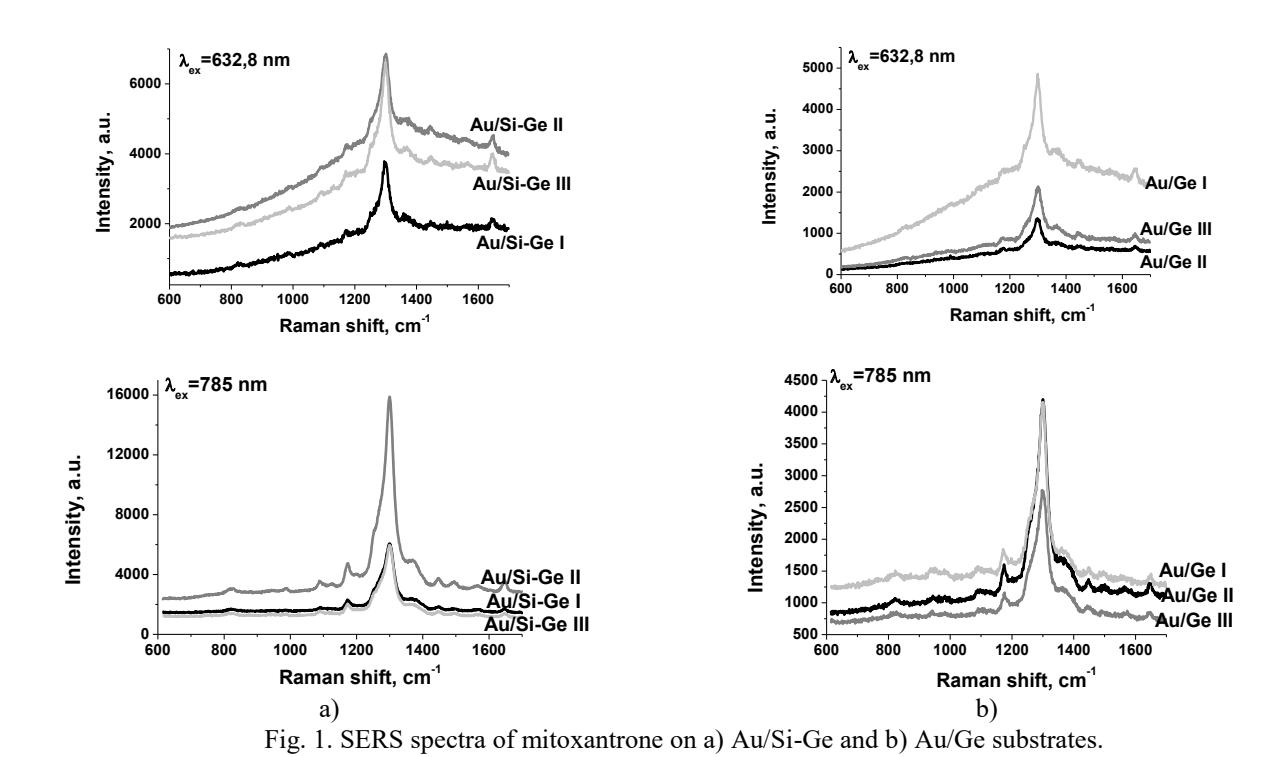
SERS spectra of mitoxantrone have an intensive peak at 1300 cm-1 (Fig.1). The intensity of this peak at excitation wavelength 632,8 nm is about 2000 a.u. for Au/Ge I, 700 a.u. for Au/Ge II and 1200 a.u. for Au/Ge III substrates. The intensity of this peak is about 2000 a.u. for Au/Si-Ge I and Au/Si-Ge II, and 3000 a.u. for Au/Si-Ge III substrates.
Using the excitation wavelength at 785 nm gives additional enhancement of SERS signal up to 1,7 times for Au/Ge I and III substrates and up to 4 times for Au/Ge II. The effect of excitation wavelength is more pronounced for Au/Si-Ge substrates. We can see additional enhancement of SERS up to 2,5 times for Au/SiGe I, up to 5,5 times for Au/SiGe II and up to 1,5 times for Au/SiGe III substrates.
Raman signals of analyte on the Si-Ge and Ge substrates without Au layer were not detected under same excitation conditions. Thus we conclude the using of Au/Si-Ge and Au/Ge substrates allows to obtain the surface-enhanced Raman scattering of mitoxantrone on 2-3 orders of magnitude.