
Palladium (Pd) nanoparticles (NPs) have gained significant attention due to their unique physical and chemical properties, such as enhanced catalytic activity and excellent electronic conductivity. These characteristics make Pd NPs particularly suitable for applications in sensors, where high sensitivity and rapid response times are required [1].
In this work, we performed the Pd NP photophysical synthesis employing a Yb:KGW femtosecond pulsed laser and micromachining system [2]. The palladium target was submerged in deionized water with a 2 mm layer covering its surface. A 1030 nm wavelength femtosecond laser with 1.9 µJ pulse energy and 0.6 J/cm² fluence at a 200 kHz repetition rate was used for ablation. The beam focused to a 20 µm spot, scanned at 20 mm/s speed with a galvanometric scanner over a 2 mm × 2 mm area with 30 µm y-direction steps. Elemental composition analysis of the synthesized nanoparticles was conducted using energy-dispersive X-ray spectroscopy (EDS). The sample analysis confirmed the formation of high-purity Pd nanoparticles.
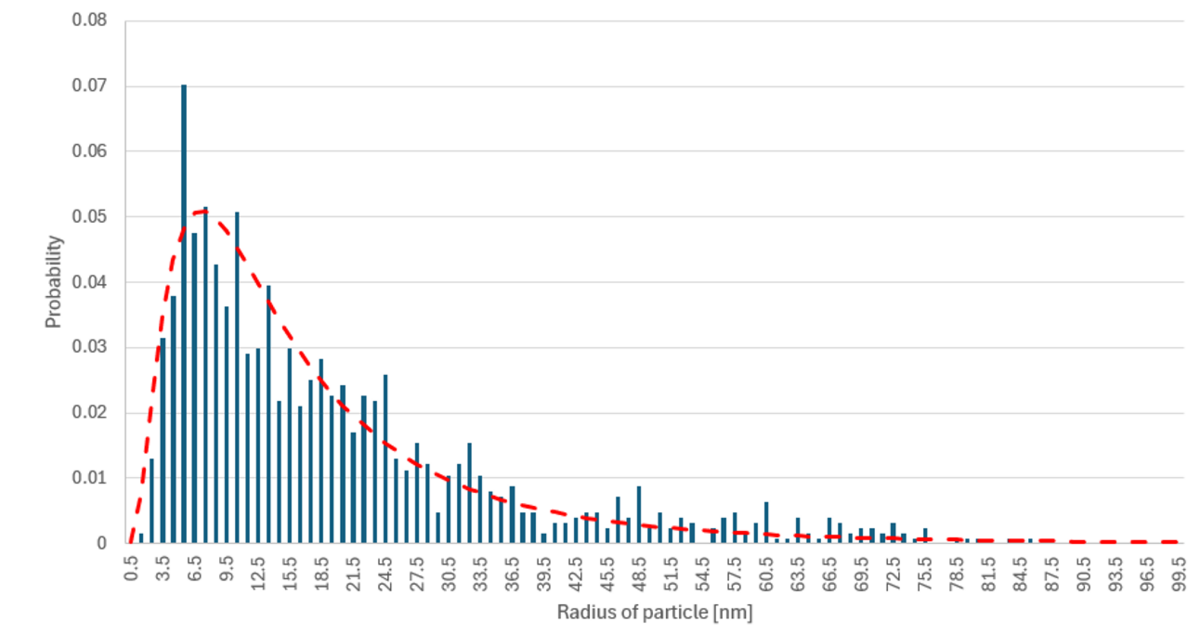
SEM micrographs of the dried Pd NPs on crystalline silicon substrate revealed that the mean diameter is 20 nm and the broad size distributions follow a log-normal distribution, which is characteristic for NPs produced via metal target laser ablation in liquid.
The research was carried out within joint research project between the Lithuanian and Czech academies – “HAMLET”.