Coherent anti-Stokes Raman scattering (CARS) is a third-order nonlinear process that is often used for vibrational imaging and spectroscopy [1]. CARS allows fast chemically specific imaging of certain vibrational modes without any need for labels. However, in most cases CARS signal contains a strong non-resonant background and it’s difficult to extract true vibrational information from measured spectra [2]. CARS microscopy can be employed for investigating diamond [3], which has no non-resonant background and has an intense line at 1332 cm\(^{-1}\), which is a frequency of C-C vibrational mode in diamond crystal lattice. Besides that, NV color centers in diamond can be used in electric and magnetic fields quantum sensing [4], while SiV and GeV color centers can be used in temperature sensing [5, 6]. In this work, epi-detection CARS experiments were conducted on various diamond-based substrates with metal structures.
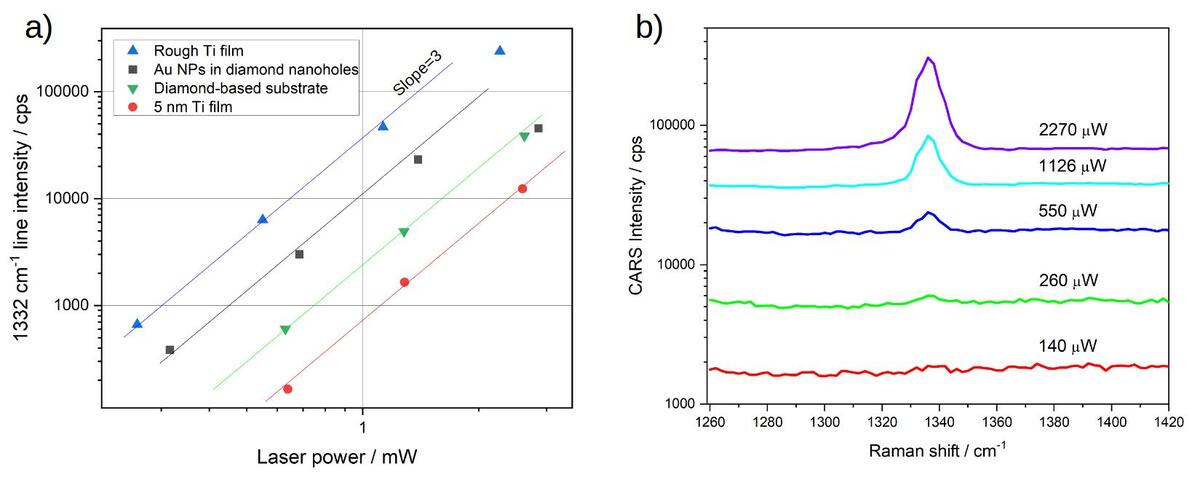
CARS images were taken and spectra were measured using 5 different laser powers, starting from the lowest to avoid sample degradation. The main sample is a substrate with diamond microneedles in Si base. It was compared with other samples that are similar diamond-based substrates, but with 5 nm metal films or different metal nanostructures on diamond surface. Au, Ag, Cu, Ti and Ni were used. Diamond-based substrate without metal structures show a 1332 cm\(^{-1}\) line in CARS spectra. Diamond line’s intensity dependence on laser power is cubic, which confirms a third-order nonlinear nature of the observed process. Background intensity dependence on laser power is close to quadratic – it is a result of other, linear and second-order processes (for example, two photon excitement fluorescence, TPEF). Au, Ag and Cu nanostructures are often used in SERS and SEIRA spectroscopy [7], but this work shows that Au and Ti structures can be used to enhance CARS signal as well. 5 nm Au film and Au nanoparticles on flat diamond surface degrade from high laser intensity, but Au nanoparticles deposited in nanoholes on diamond surface enhance diamond CARS signal because of plasmonic effects. Diamond-based substrate with rough Ti film has great signal enhancement properties and we propose similar plasmonic mechanism for this enhancement since flat metal surfaces don’t enhance CARS signal in conducted experiments. Comparison of diamond resonant line intensity dependence on laser power using various diamond-based substrates is presented in fig. 1. Diamond-based substrates with other metals (Ni, Cu, Ag) degrade from high laser power in these experiments. The obtained results reveal that Au and Ti nanostructures can enhance diamond CARS signal.