
By now, it is well established that most massive galaxies host a supermassive black hole at their centres. Occasionally an interstellar gas cloud intersects its sphere of gravitational influence; then, a hot accretion disc forms and often launches a relativistic particle wind - an active galactic nucleus (AGN) phase begins. Active nuclei flicker in bursts lasting several hundred thousand years, followed by quiescent intervals. Cumulative energy released by the nuclear activity is well above the gravitational binding energy of the galactic bulges. This indicates the coupling of AGN-released energy to surrounding gas must be inefficient, although capable of altering the star formation rates as inferred from the observed black hole mass-stellar velocity dispersion relation [1]. A successful model [2] has been developed in which the relation forms primarily by AGN wind-driven outflow interaction with the surrounding gas. Fast outflows (>500 km/s) simply remove the gas from the bulge, quenching star formation. On the other hand, the effect of slower outflows is debated. There is observational evidence and numerical simulations [3] to support the possibility of positive feedback, i.e. star formation enhancement, but it is limited to slow, warm-to-hot outflows below 200 km/s.
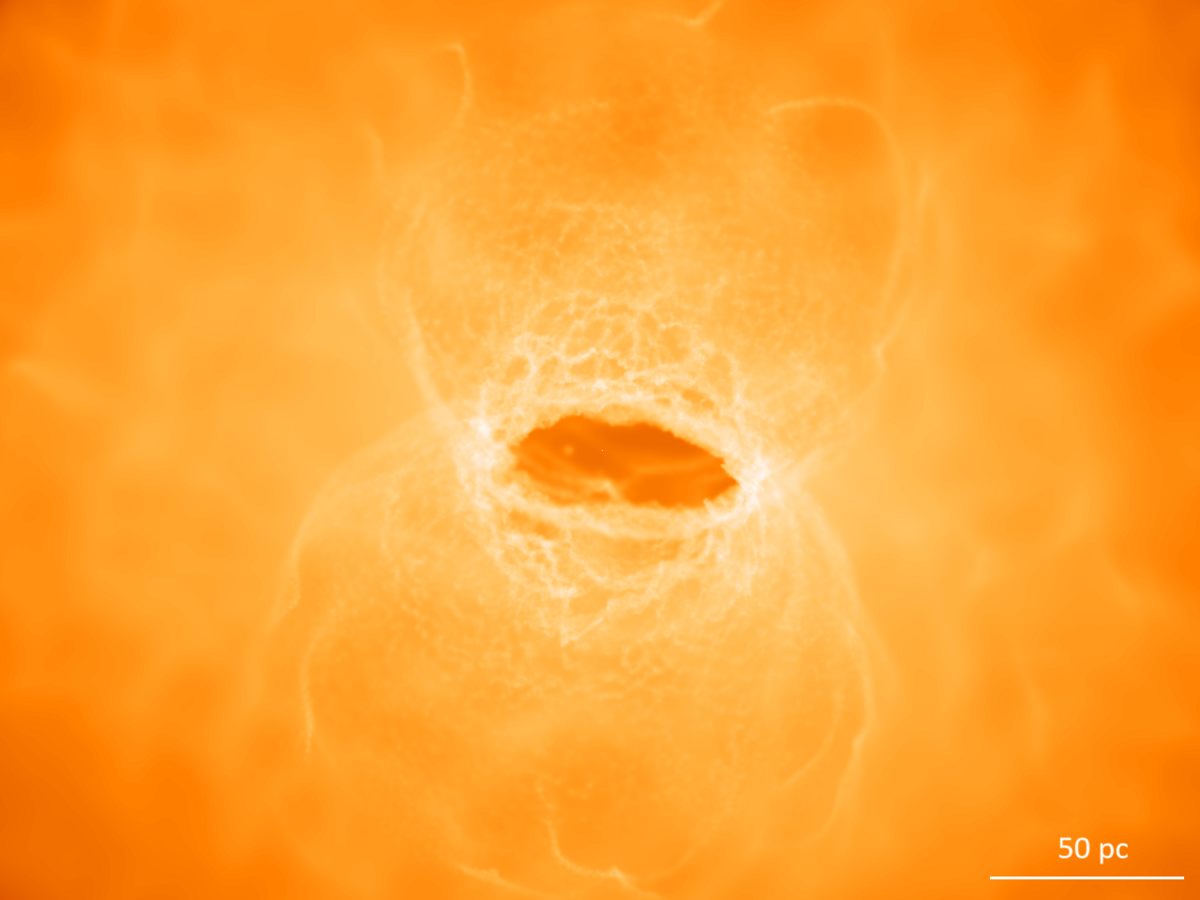
We aim to further constrain the conditions required for positive feedback to manifest. We use numerical simulations to investigate the formation and propagation of an AGN-driven outflow in a realistic environment. We utilise the SPH/N-body code Gadget3 supplemented with an AGN-wind-based feedback prescription and a simplified radiative transfer. We model the evolution of a 600-pc-wide region composed of a turbulent gas shell distributed approximately isothermally, evolving in a rotating isothermal potential, with a SMBH embedded in the centre (see Fig.1). We track the propagation of a multiphase outflow created by a single Eddington-limited AGN episode. As it expands through the initially spherical approximately isothermal gas shell, the outflow both enhances star formation in the galactic disc and forms stars itself as it fragments. On the other hand, the long-term effect is negative as the outflow expels large amounts of gas. I will detail the relative importance of negative and positive feedback and their impact on the radial and velocity distributions of the stellar population.
Observations so far have provided only limited evidence of positive AGN feedback, but this should change with upcoming surveys. Our results can be used to reconstruct recent galactic activity from observed AGN-enhanced star formation, or provide insights into the contribution of positive AGN feedback to the scatter of the M-sigma relation.