Bioactive room temperature ionic liquids (b-RTILs) are room temperature-molten salts compatible with living organisms. RTILs are becoming more popular in the scientific community due to the high number of ion combinations and tunability. Specifically, b-RTILs are applied in the medical field in drug delivery systems and to increase non-soluble drug solubility in water [1]. One of the important parameters of ILs is diffusion because it gives us information about the size or structure of molecules and how molecules interact with each other due to the change in concentration [2]. The main objective is to investigate diffusions of two b-RTILs: choline lysinate ([Ch][Lys]) and choline tryptophanate ([Ch][Trp]) in a water mixture using DOSY. [Ch] cation is involved in the metabolism process while [Trp] and [Lys] anions are involved in protein biosynthesis.
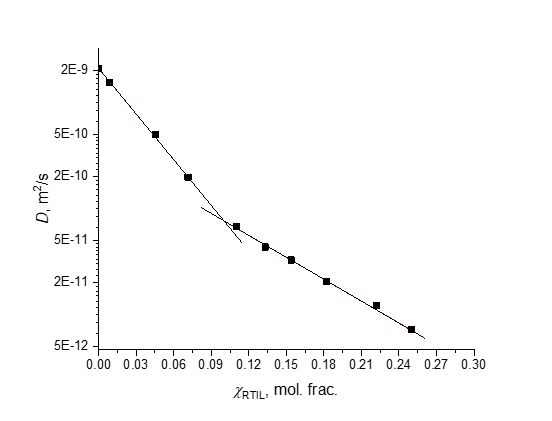
DOSY (Diffusion-Ordered Spectroscopy) is a powerful NMR (Nuclear Magnetic Resonance) tool for measuring the diffusion coefficient of a specific proton. The gradient of a magnetic field is applied to the sample. Due to magnetic field inhomogeneity, the magnetic spin orientation of protons across the sample differs. Also, due to the constant movement of molecules, the intensity of the spectra is lower than with a homogenous magnetic field across the sample. The change in the intensity also depends on the size of the molecule. Using the DOSY method, it was found that there are two diffusion regimes in [Ch][Lys]. 1 fig. shows how the diffusion of water changes according to the change in IL concentration. The same applies to [Ch] and [Lys] ions. The diffusion gradually decreases to the concentration χ\(_{RTIL}\) = 0.1 mol. frac. From that concentration, the diffusion coefficient decreases more slowly, meaning that the regime of diffusion changes. It’s also corresponding to the chemical shift minima seen in [Ch][Lys] protons. The regime change can be due to a change in the interaction of the water molecules between themselves and the protons of [Ch][Lys]. The change of regimes cannot be seen in [Ch][Trp] where the [Ch][Trp] and water diffusion coefficients gradually decrease with increasing IL concentration.
The results can be used to analyse how molecules behave at the higher IL concentration, especially around from χ\(_{RTIL}\) = 0.1 to 0.15 mol. frac.