Terahertz (THz) radiation, spanning frequencies from 100 GHz to 10 THz, has low non-ionizing energy and can penetrate various dielectric materials [1]. This property makes it valuable in fields like security screening, quality control in manufacturing, imaging, and bio-fabric analysis [2]. Traditionally, these applications have depended on large, costly lenses or mirrors to control beam propagation, limiting their practicality. A promising approach to miniaturizing these systems is the use of metalenses. These lenses integrate a phase profile with metaatoms—subwavelength geometric structures like split-ring resonators—to manipulate phase delay and polarization rotation effectively.
This research covers numerical simulations conducted to determine the appropriate complementary split-ring resonators (CSRR) metaatoms for integration into a 253 GHz metalens design. Non-paraxial and axicon metalenses were created with F=30 mm focal length and d=60mm focal depth, respectively. Both lenses were designed with 2 and 4 subzones and evaluated numerically. Results led to the selection of two metalenses for physical fabrication by laser ablation method.
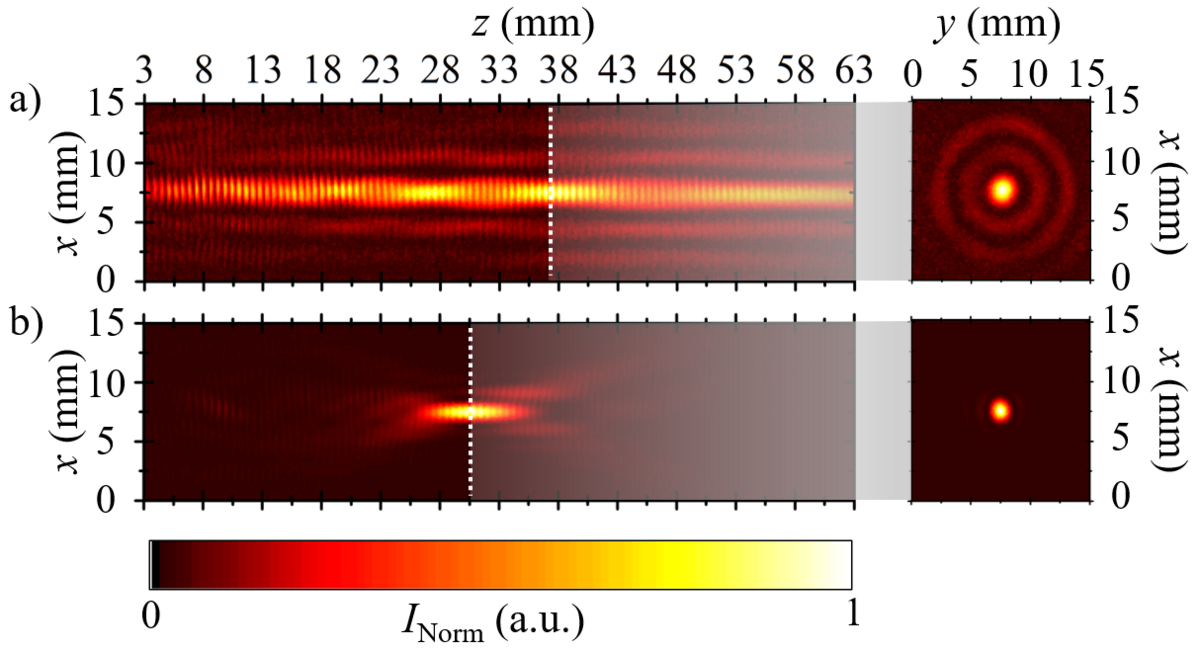
Firstly, the non-paraxial and axicon metalenses focusing performance was experimentally evaluated (Fig. 1). Then applied in direct imaging setup, where USAF 1951 resolution evaluation target was used. System with focusing non-paraxial metalens achieve high: 0.63λ resolution, while focusing with axicon metalens reaches 0.85λ resolution and allows to position target not so precisely or even cover focusing element.