
Solar energy is one of the most promising ways to generate electricity through photovoltaic conversion in solar cells. Currently, the most widely used silicon solar cells, while widely available, have significant limitations: they are material-intensive to manufacture, very brittle, and exhibit reduced efficiency at elevated temperatures [1]. To address these challenges, hybrid organic-inorganic materials have emerged as a potential alternative. In particular, the integration of structural textiles with inorganic semiconductors offers a route to more efficient and flexible solar cells due to their excellent optical and electrical properties, including high theoretical efficiency, robust thermodynamic stability, low toxicity and low-cost fabrication [2, 3].
This study focuses on evaluating the optimisation of etching parameters to improve the surface compatibility of structural textiles and inorganic semiconductors.
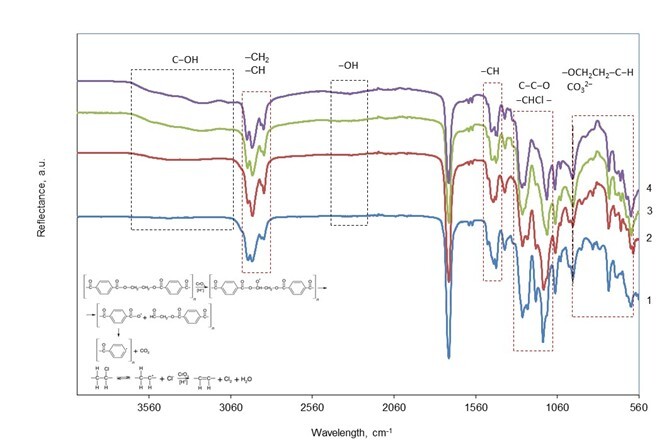
In order to determine the appropriate etching parameters, the process was evaluated by monitoring the appearance of hydroxyl groups on the surface after treatment in the etching solution consisting of acid and oxidant [4]. Samples of several commercially available structural textiles were treated in this solution for 2, 4 or 6 hours at a temperature of 70-100°C. The samples were then rinsed with hot water, distilled water, dried and the attenuated total reflection Fourier transform infrared (ATR-FTIR) spectra recorded. After etching to determine the degree of etching required to ensure adhesion of the deposited semiconductor layer to the as-prepared samples, a very simple, inexpensive and economically reproducible SILAR method was used to deposit Ag₂S thin films at room temperature [5].
It was found that optimal surface modification was achieved when -OH groups were formed, as observed in the ATR-FTIR spectra (Fig. 1). This suggests increased surface hydrophilicity, which is expected to improve the adhesion of the deposited Ag₂S layer.
Successful deposition of Ag₂S thin films on appropriately treated polymer substrates could pave the way for the development of flexible, efficient, and cost-effective hybrid solar cells. Future work will focus on optimizing the deposition of Ag₂S thin films and evaluation of the ability to use them for solar cells.