
Dissolved heavy metals in wastewater represent a significant threat to environmental and public health due to the persistent toxicity of these pollutants [1]. Traditional treatment methods, such as chemical precipitation and membrane ultrafiltration are energy-intensive and may not be sustainable over the long term [2]. In contrast, biological processes offer a promising alternative by harnessing the inherent capabilities of microorganisms to capture heavy metals, using methods, such as bioprecipitation, biosorption, and bioaccumulation [3]. In this study, we examine the heavy metal bioaccumulation capacity of the protozoan Tetrahymena thermophila.
Tetrahymena thermophila was selected for this study because of its extensive documentation in literature, its complex metallothionein systems, rapid growth rate, and minimal ethical concerns; all of which underscore its potential for large-scale heavy metal treatment applications [4].
We evaluated the bioaccumulation capacity of Tetrahymena thermophila in saturated cultures exposed to zinc (Zn²⁺), molybdenum (Mo²⁺), copper (Cu²⁺), trivalent chromium (Cr³⁺), and hexavalent chromium (Cr⁶⁺) over a three-day period with concentrations chosen to match similar toxicity levels. The results demonstrated that T. thermophila maintained growth, altered its metabolic pathways, and displayed significant bioaccumulation capabilities under heavy metal exposure. However, prolonged resistance was not achieved, and the cultures eventually succumbed to toxicity. Notably, chromium exposure indicated the presence of a reversible ion-binding mechanism.
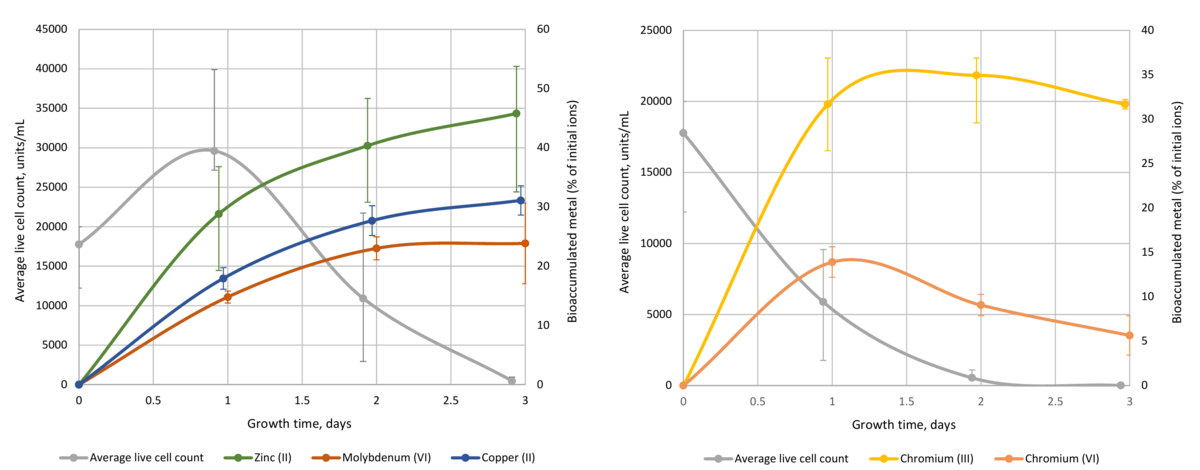
These results suggest that T. thermophila is effective at reducing heavy metal concentrations through bioaccumulation. When integrated with sustainably sourced nutrients, this biological treatment approach has the potential to significantly lower the energetic demands associated with conventional treatment processes.