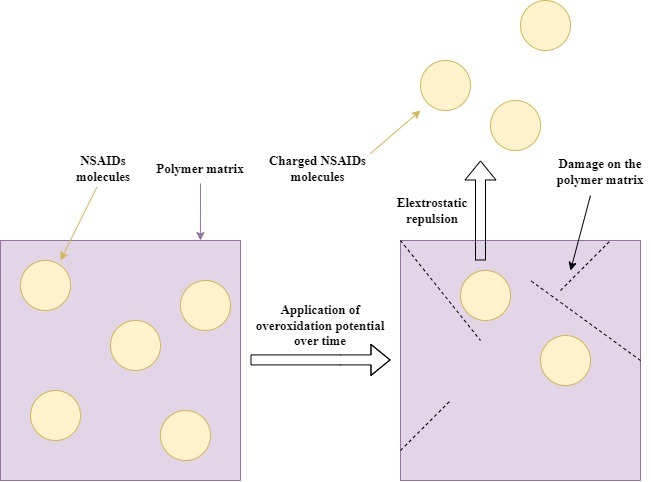
Controlled drug delivery is an important research topic in both academia and industry because of its impact on pharmacokinetics and patient compliance. Traditional drug administration does not always ensure targeted delivery, potentially causing undesired side effects. To address this, drug delivery systems are being developed to enable targeted and controlled drug release in response to external stimuli. Our primary goal was to explore the opportunities of using conductive polymers (CP) as carriers for non-steroidal anti-inflammatory drug (NSAIDs), and to develop a controllable drug delivery system for NSAIDs that regulates both its concentration and release time. In this work we focused on employing conductive polymer matrices as a platform for controlled drug release.
To make this system we first electrochemically deposited CP matrix on platinum electrode using potentiometric detection and cyclic voltammetry methods in a solution of CP with NSAIDS and electrolyte. To release the embedded NSAIDs form the CP overoxidation potential over time was applied. Release of NSAIDs was monitored with UV-Vis spectrophotometry where we used the electrolyte as the reference.
The potential applications of this system could be utilized in medical devices for localized drug delivery and reducing systemic side effects.