
An aerosol is defined as a suspension of a liquid or solid particles suspended in a gas. Aerosols are a key contributor to environmental issues such as global warming, photochemical smog, and poor air quality. The health risks of aerosol exposure in urban areas pose a significant health concern. Awareness of the potential health impacts from aerosol anthropogenic sources particularly those associated with fine particles has increased only in recent years. The problem of environmental pollution in cities is relevant and the need to know the sources of pollution is a very important aspect for monitoring and reducing pollution [1]. The aim of this study was to determine the sources of aerosol particles using positive matrix factorization in an urban background environment. Measurements were performed from January 2 to December 21, 2019 at the urban background site located at the Vilnius. 100 samples of PM2.5 were collected on polytetrafluoroethylene filters and investigated by broad-beam particle-induced X-ray emission (PIXE) using 1.9 MeV protons. A proton beam, accelerated using a Tandetron 4110A ion accelerator and collimated to a diameter of 5 mm, was used to irradiate the samples. A single spectrum was measured for each PM2.5 sample, and the ppm (ng/cm3) levels were evaluated by assuming homogeneous deposition of PM on the filters. X-ray spectra are recorded using a Canberra SL30165 Si(Li) detector with 165 eV energy resolution at 5.894 keV and Canberra DSA1000 MCA. The distance between the sample and the detector was 59.5 mm (8.5 msr). X-ray spectra were fitted using the GupixWin software package for quantitative elemental analysis. The NIST-2783 standard reference material (PM2.5 deposited on the filter) was used to calibrate the X-ray yield. Eleven elements (Al, Si, K, Ca, Cr, Mn, Fe, Co, Ni, Cu, and Zn) were identified in the analysed samples. Figure 1 shows the distribution of concentrations of 11 identified elements and their presence in the factors. 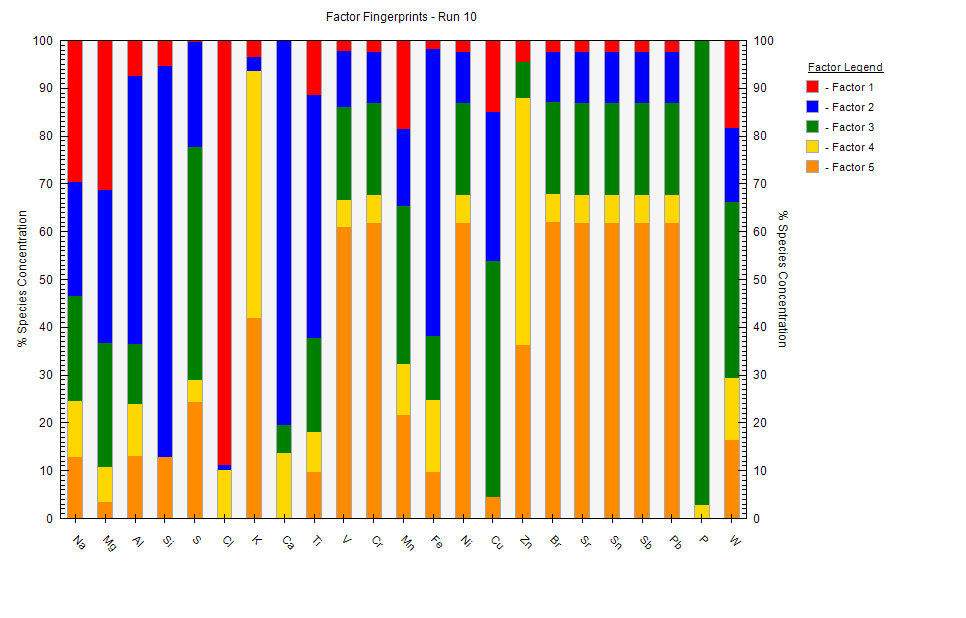
SOURCE APPORTIONMENT OF AEROSOL PARTICLES BY POSITIVE MATRIX FACTORIZATION IN URBAN BACKGROUND ENVIRONMENT (VILNIUS, LITHUANIA)
Viachaslau Alifirenka1, Vitalij Kovalevskij1, Mindaugas Gaspariūnas1, Mindaugas Bernatonis2, Steigvilė Byčenkienė1
1 SRI Center for Physical Sciences and Technology (FTMC), Saulėtekio ave. 3, LT-10257 Vilnius, Lithuania
2 Environmental Protection Agency, A. Juozapavičiaus str. 9, LT-09311 Vilnius, Lithuania
Fig. 1. PM2.5 factors(sourses) profile for Vilnius urban background area from 2 January to 21 December 2019
[1] Aerosol science: Technology and applications. Ian Colbeck, Mihalis Lazaridis, 2014