
Large-diameter dead wood is an important component of the forest ecosystem and an indicator of sustainable forestry, which supports ecosystem diversity by providing natural habitats for many species of organisms [1]. Insects of the order Hymenoptera are extremely diverse in dead wood. This group is particularly rich in parasites, decomposers, and predators. They play an important role in the wood decay process and in controlling forest pest populations [2]. In the past, Hymenoptera associated with dead wood are rarely studied in Lithuania. Therefore, in order to preserve these insects, it is important to study the habitats in which they live. The aim of the study was to assess the diversity of Hymenoptera in the dead wood of four species of deciduous trees of the second decay class in unmanaged forests in Lithuania.
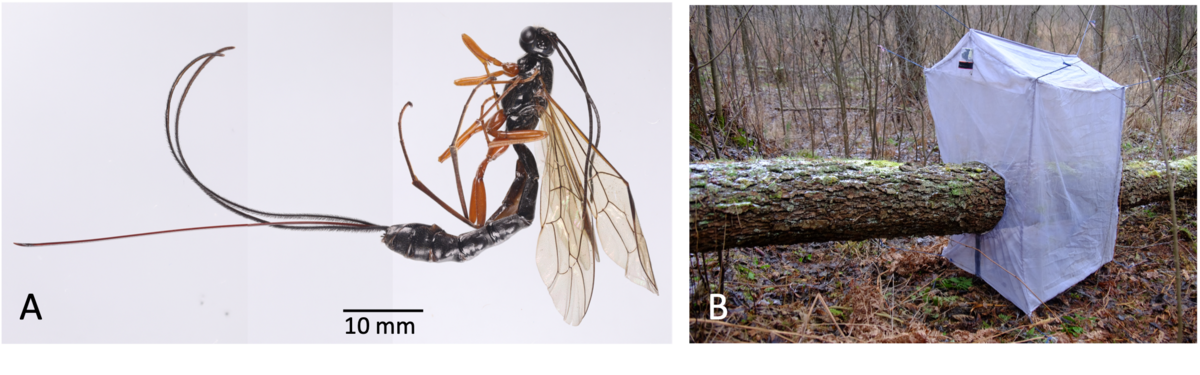
The study was conducted in old-growth forests of Lithuania: Būda Botanical-Zoological Reserve; Dubrava Reserve Area; Punios Šilas Strict Nature Reserve. These areas are part of the „Natura 2000“ ecological network of European importance. Insects were caught in 2021 from May to September. 18 trunk-emergence-type traps were installed on 4 tree species (Alnus glutinosa, Betula sp., Populus tremula, Quercus robur) of large-diameter deadwood trunks of the second decay class, covering a 1-meter section of deadwood (Fig. 1, B). The collected insects were described in the laboratory based on morphological characteristics to the family or subfamily level.
During the study, 1157 individuals of the order Hymenoptera from 12 superfamilies and 24 families were identified. The Aculeata group consisted of 231 individuals, most of which belonged to the family Formicidae (208), the Parasitica group consisted of 926 individuals with the most abundant family Ichneumonidae (191) (Fig. 1, A). On average, the largest number of individuals were caught from Q. robur trunks. The least number of different taxa (families) was captured on average from A. glutinosa, while the average number of different taxa was similar in other trees. Individuals from 12 families were caught from all tree species, and 7 from the wood of only one tree species. The family Ichneumonidae consisted of 14 different subfamilies. The highest average number of Ichneumonidae individuals caught was from Q. robur, and the lowest was from P. tremula.
The results of the study show that dead wood of deciduous trees is characterized by an extremely high diversity of Hymenoptera insects, especially parasitic wasps. Further research is needed to more fully assess the diversity of Hymenoptera in dead wood. By studying their habitat needs, these indicators could be used in protective habitat management.
A. glutinosa trunk