Bessel beams are categorised under non-diffractive beams. They can be formed using a conical prism (axicon). The resulting interference of the optical waves creates a Bessel beam which can have a larger depth of focus compared to Gaussian beam [1], self-healing property [2], and higher resistance to spherical aberrations [3]. Bessel beams are used in optical trapping, superresolution imaging, material processing, and in other applications [1]. Such beams are attractive for glass scribing due to the ability to vary the depth of focus by changing the diameter of incoming Gaussian beam or using different half cone angles of the Bessel beam facilitating the formation of elongated modifications. Additionally, transverse direction of the modifications can be controlled with asymmetrical beams, so that cracks align with the direction of scribing, which increases scanning speed, decreases separation stress and side wall roughness [4].
Increasing the number of laser pulses in the MHz regime has been shown to produce longer transverse cracks [5]. These larger cracks help to increase scribing speed. Furthermore, the ability to control crack direction through polarisation has recently been demonstrated using a loosely focused Gaussian beam and burst regimes [6]. Investigating this phenomenon with other types of laser beams is of particular interest.
In this study, scanning speed, burst energy, linear and circular polarisation effects on transverse crack formation were investigated scribing 1 mm thickness soda-lime glass samples with Bessel beam. Ultrashort pulse laser FemtoLux 30 from Ekspla was used for the experiment operating in MHz burst regime. Separation stress was measured by breaking samples with a four-point bending setup. Roughness of the samples was measured with a confocal profilometer.
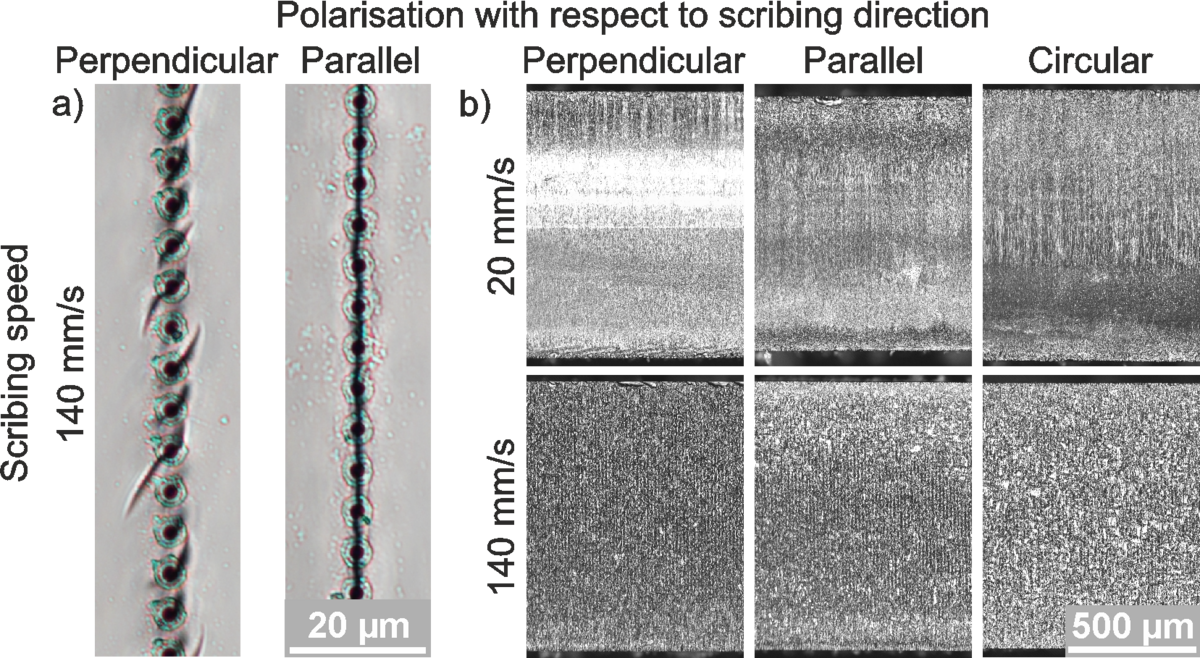
Optimal scribing speeds and burst energies were found which resulted in lowest separation stress or roughness for polarisation aligned with scribing direction, perpendicular to it, and for circular polarisation. Fig. 1 shows how cracks align in the scribing direction when polarisation is parallel to it and sidewall images by optical microscopy. When using low burst energies crack formation angle corresponds to linear polarisation angle.