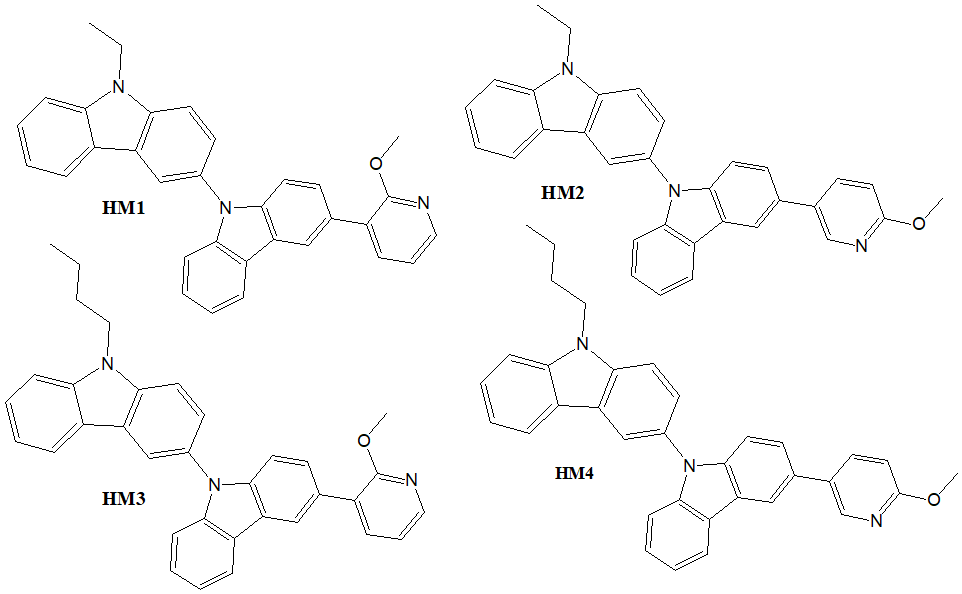
Over the past decade, organic light-emitting diodes (OLEDs) have been widely tested in next-generation electronic devices due to potential applications in full-color flat-panel displays and solid-state lighting. Compared with traditional liquid crystal display, OLEDs have many unique features, such as high contrast, wide viewing angle, low driving voltage, flexibility, fast response, and lightweight [1-3]. Organic electroactive materials are extensively synthesized and studied as components of the mentioned devices. Here, we present new carbazole-based derivatives with carbazole rings as electron-donating fragments and pyridinyl fragments as electron acceptors. The structures of materials HM1-HM4 are shown in Figure 1.
Fig. 1. The structures of materials HM1-HM4
The electroactive derivatives demonstrated suitable thermal, film forming and optoelectronic properties as potential host materials for green-emitting phosphorescent Ir(ppy)\(_{2}\) guest and were applied for preparation of the efficient devices. The objective materials have very high thermal stabilities (temperatures of 5% weight loss 371-387 \(^{o}\)C) and can form amorphous layers, also having rather high glass transition temperatures in the region of 89-97 \(^{o}\)C. Triplet energy gaps of the four compounds were about 2.7-2.8 eV, making them appropriate for use as host materials in green phosphorescent OLEDs with Ir(ppy)\(_{3}\) guest. Also, a composite host system incorporating a synthesized HM host and bis-4,6-(3,5-di-3-pyridylphenyl)-2-methylpyrimidine was developed to enhance hole and electron transport within the emitting layer. Notably, the device using 9-(9-butylcarbazol-3-yl)-3-(2-methoxypyridin-3-yl)carbazole (HM2) host outperformed the other devices, achieving peak efficiencies of 16.9% (58.3 cd/A and 65.0 lm/W) with maximum luminance exceeding 241100 cd/m\(^{2}\). Finally, these results confirm that the specific molecular and device architecture designs are effective, providing new ways for developing efficient emitting layers of the OLED devices in future. We gratefully acknowledge the funding support from the Research Council of Lithuania (grant No. S-MIP-22-84) and from the National Science and Technology Council of Taiwan, under the grant number (MOST 111-2221-E-155-012-MY2 and NSTC 112-2923-E-155-002-MY4).
[1] H. W. Chen, J. H. Lee, B. Y. Lin, S. Chen, S. T. Wu. Liquid crystal display and organic light-emitting diode display: present status and future perspectives (Light. Sci. Appl., 2018;7:17168)
[2] X. Wu, X. Yan, Y. Chen, W. Zhu, P. T. Chou. Advances in organic materials for chiral luminescence-based OLEDs. (Trends. Chem., 2023;5:734-47)
[3] I. Siddiqui, S. Kumar, Y. F. Tsai, P. Gautam, K. Shahnawaz, K. Kesavan, et. al. Status and challenges of blue OLEDs: A review. (Nanomaterials 2023;13:2521)