
Transition towards sustainable and renewable energy requires development of energy storage technologies such as Na-ion based batteries. Promising sodium ion batteries (SIB) are aqueous NASICON (Na Super Ionic CONductor) based batteries. NASICON materials feature a stable three-dimensional crystal structure, good ionic conductivity, and thermal stability. NASICON can be used as anodes, cathodes, solid electrolytes, or electrode coating materials [1] in battery development. To efficiently and successfully use these technologies, it is necessary to understand the chemical processes that limit the effective usage time of the batteries. Solid-state Nuclear Magnetic Resonance (NMR) spectroscopy is a powerful method that can assist in the study of these processes. NMR spectroscopy is already used in battery research, but most of the applied methods are ex-situ experiments, during which the batteries are disassembled, and the environment of the materials under study is altered. To avoid this, in-situ NMR methods can be applied, where measurements are carried out without disassembling the electrochemical device. 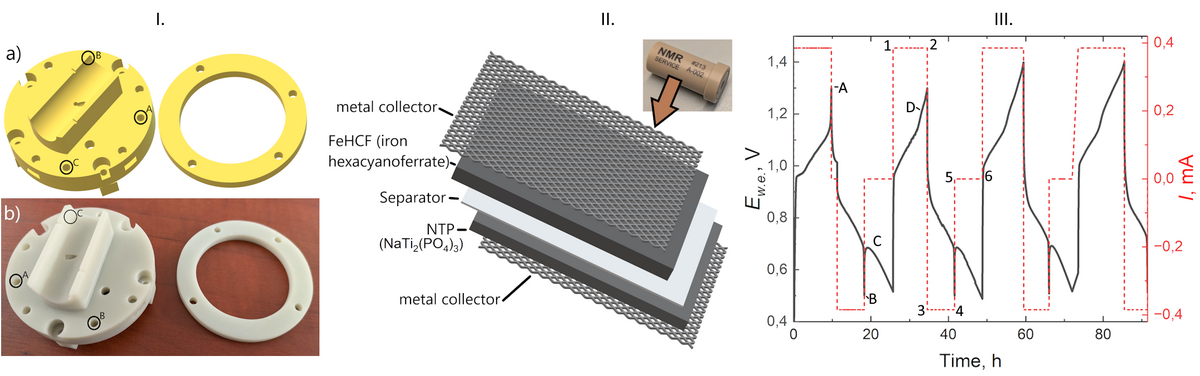
We modified the commercial 5 mm wideline NMR probe that 11 mm in-situ cell is compatible and tuned the NMR probe to \(^{31}\)P and \(^{23}\)Na resonances. Two NMR probe setups with distinct electrical circuits for impedance matching were created: shunt inductive and series capacitive matching circuits. Three additional channels were introduced for charging and discharging (cycling) the battery. Nutation curves and spectra were registered for the purpose of NMR probe setups comparison. Shunt inductive NMR probe setup was tested by measuring \(^{31}\)P spectra of aqueous NASICON based battery during charge–discharge cycling. Registered working electrode spectra of time dependant voltage showed when parasitic competing oxygen evolution reaction becomes significant. By examining NTP (NaTi\(_{2}\)(PO\(_{4}\))\(_{3}\)) \(^{31}\)P spectra of different cell configurations, and by comparing nutation curves of different NMR probe setups adequate NMR probe and cell configurations were determined for aqueous NASICON battery in-situ research.