
Yttrium aliuminium garnet (YAG) has been a laser gain medium for over 60 years [1]. Czochralski synthesis method has been used as the primary production method of YAG monocrystals [2]. While polycrystalline YAG has a higher number of synthesis methods available for its production [3,4], none of them are suitable for the fabrication of complex 3D YAG microstructures. This work aims to show that two-photon polymerization laser 3D printing [5] can produce polycrystalline 3D luminescent YAG:Ce microstructures via the post-processing calcination step [6,7]. 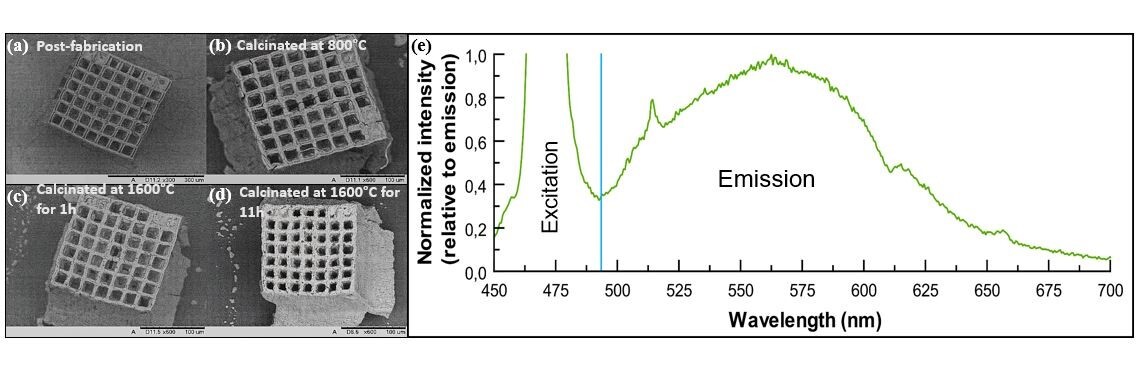
LASER DIRECT WRITING 3D PRINTING OF LUMINESCENT YAG:Ce MICROSTRUCTURES
A. Harnik1, R. Virkėtis2, D. Dapšys1, D. Ladika1, G. Merkininkaitė2, S. Šakirzanovas2, M. Malinauskas1
1 Laser Research Center, Faculty of Physics, Vilnius University, Saulėtekio Ave. 10, LT- 10223, Vilnius, Lithuania
2 Institute of Chemistry, Faculty of Chemistry and Geosciences, Vilnius University, LT- 03225, Naugarduko Str. 24, Vilnius, Lithuania
[1] Zac, “Is It Time To Invest In A Cutera YAG Laser?“, laserresell,, May 16 2022, https://laserresell.com/buying-usedequipment/cutera-yag-laser/, (Accessed: 27 June 2024).
[2] Ikesue, A., Aung, Y. L., and Lupei, V., [Ceramic Lasers], Cambridge University Press (2013).
[3] B. Bettes and Yi Xie, “Synthesis and processing of transparent polycrystalline doped yttrium aluminum garnet: a review”, Mater. Res. Lett., 11-1, 1-20 (2023).
[4] A. Towata, H. J. Hwang, M. Yasuoka, M. Sando and K. Niihara, “Preparation of polycrystalline YAG/alumina composite fibers and YAG fiber by sol–gel method”, Composites, A 32 (8), 1127-1131 (2001).
[5] G. Zyla and M. Farsari, “Frontiers of Laser-Based 3D Printing: A Perspective on Multi-Photon Lithography“, Laser Photonics Rev., 18-7, 2301312 (2024).
[6] G. Merkininkaitė, E. Aleksandravičius, M. Malinauskas, D. Gailevičius and S. Šakirzanovas, „Laser additive manufacturing of Si/ZrO2 tunable crystalline phase 3D nanostructures”, Opto-Electron Adv., 5, 210077 (2022).
[7] A. Harnik and et al., „Laser 3D micro-/nano-structurization of luminescent materials“, Appl. Mater. Today, IN REVIEW (2025).