QUANTUM MANY-BODY PHASES IN SUBWAVELENGTH BRICK WALL LATTICE

D. Viarbitski1, D. Burba1, G. Juzeliunas1, G. Žlabys2

1 Institute of Theoretical Physics and Astronomy, Vilnius University, Sauletekio 3, Vilnius, Lithuania

2 Okinawa Institute of Science and Technology Graduate University, Okinawa, Japan

[email protected]

The study of quantum many-body systems has led to the discovery of numerous exotic quantum phases of matter, driven by the interplay between particle interactions, quantum fluctuations, and symmetry breaking. Among these, pair superfluids [1] and supersolids are particularly fascinating, as they represent different manifestations of quantum coherence and collective behavior in strongly correlated systems. In this paper, we propose a state-dependent lattice [2] for ultracold bosons based on a particular tripod atom-light coupling scheme [3]. We show that it manifests an extended Bose-Hubbard model and we explore the emergence of novel quantum phases, chief among them (pair) superfluids, supersolids, and Mott insulators.

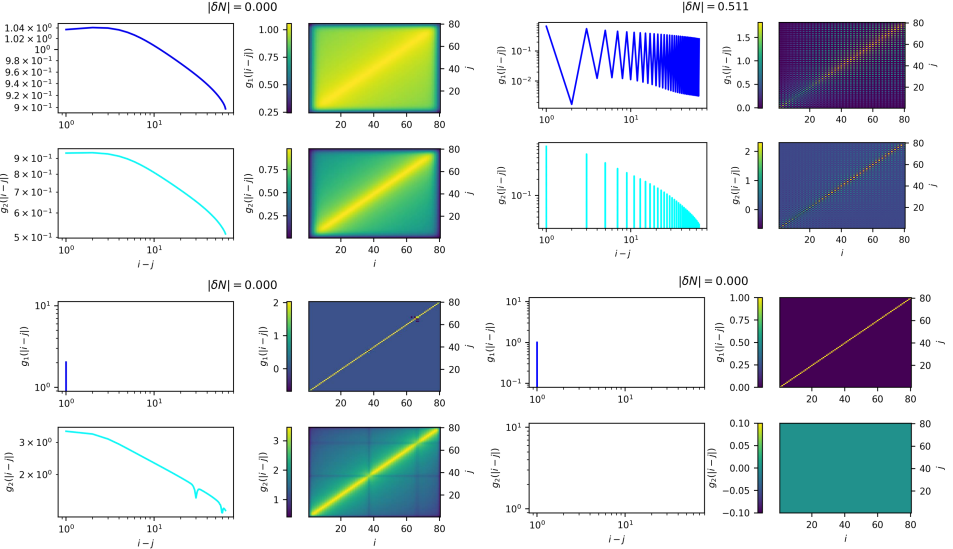
Figure 1
Fig. 1. Bottom-right (MI): Quantities for following p-band parameters in canonical ensemble: J1 = J2 = 0, g0 = 1.0, gx = 0, gz = 0, G000 = 1.0, G011 = −G001 = 0.5, Npart = Nlat , Nlat = 80, boson-dim= 6 Top-right (SS): Quantities for following p-band parameters in canonical ensemble: J1 = −0.1/ √10, J2 = 0.1, g0= 0.5, gx = −0.5, gz = 0.05, G000 = 1, G011 = −G001 = 0.5, Npart = Nlat , Nlat = 80, boson-dim= 6. Top-left (SF): Quantities for following p-band parameters in canonical ensemble: J1 = J2 = 0, g0 = 1.0, gx = 0, gz = 1.0, G000 = 1, G011 = −G001 = 0.5, Npart = Nlat , Nlat = 80, boson-dim= 6. Bottom-left (PSF): Quantities for following p-band parameters in canonical ensemble: J1 = J2 = 0, g0 = 0.1, gx = 1.0, gz = 0, G000 = 1, G011 = −G001 = 0.5, Npart = 2Nlat , Nlat = 80, boson-dim= 6.


[1] X.-F. Zhou, Y.-S. Zhang, and G.-C. Guo, Phys. Rev. A 80,013605 (2009)

[2] M. Eckholt and J. J. García-Ripoll, New Journal of Physics 11, 093028 (2009)

[3] E. Gvozdiovas, P. Račkauskas, and G. Juzeliunas, SciPost Phys. 11, 100 (2021)