It is generally accepted that the unbalanced use of mineral fertilizers in pursuit of the highest possible yield has a negative effect on the ecosystem. Therefore, recently, ways have been sought to replace at least part of mineral fertilizers with organic ones, which have a number of advantages over mineral fertilizers, especially in the long term. Organic fertilizers improve soil structure, increase its aeration, promote the accumulation of humus, which increases the soil’s ability to retain moisture and nutrients, while helping to maintain a healthy soil ecosystem, help accumulate carbon in the soil, reducing the amount of CO₂ in the atmosphere and contributing to climate change mitigation. They also feed beneficial microorganisms that help decompose organic matter and release nutrients for plants. Unlike mineral fertilizers, which often dissolve quickly and can be washed away by rain or irrigation, organic fertilizers release nutrients gradually, ensuring a long-term supply to plants, reducing the risk of nitrogen compounds and phosphorus entering water bodies and causing eutrophication. Organic fertilizers are usually produced from renewable sources, therefore contributing to the circular economy and waste recycling.
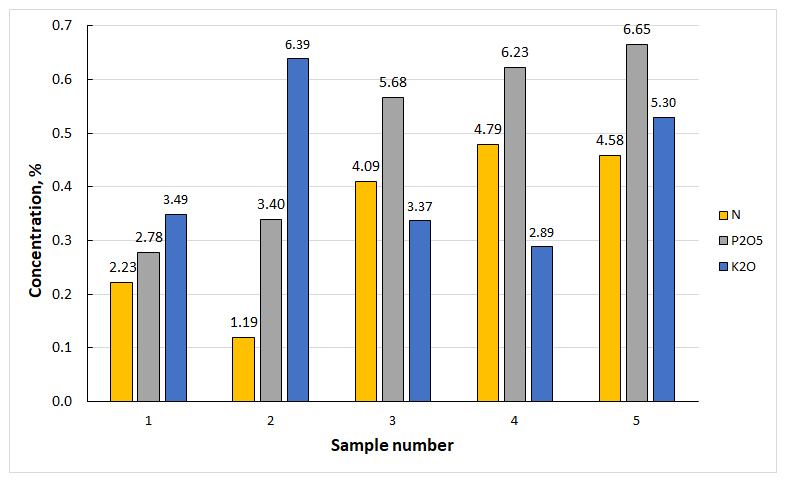
However, the concentration of nitrogen, phosphorus and potassium in organic fertilizers can vary greatly depending on their origin, composition and processing method and is more difficult to control than in mineral fertilizers, where these nutrients are provided in pure compounds and precisely dosed. The composition of organic fertilizers depends on: the type of raw material, the processing method, the degree of maturity. Typically, the most nitrogen is found in poultry manure (4–6% N), phosphorus is found in bone meal (12–30% P₂O₅), and potassium is found in ash (10–35% K₂O). In this work, granular organic fertilizers from various waste: uncleaned buckwheat biomass (UBM), buckwheat husks (BH), buckwheat husk ash (BHA), bone meal (BM), molasses solution (MS), and beaten eggs (BE) were produced using different dry and liquid raw materials. By changing their ratio, the aim was to create organic fertilizers of various compositions (Fig.1.) that would be suitable for use in different periods of plant vegetation.