Inertial Confinement Fusion (ICF) is a fusion energy approach that uses intense laser or X-ray pulses to rapidly compress and heat a tiny fuel capsule, creating the extreme conditions needed for nuclear fusion. It has the potential to provide an almost limitless, clean, and sustainable source of energy, with possible applications in energy production, nuclear research, astrophysics, high-energy physics, and theoretical space propulsion.
Micro-foam targets are used in ICF experiments and must have high porosity, be composed of light elements (with carbon as the heaviest), and maintain uniform density. Various manufacturing methods can produce these foam targets, including 3D printing, carbon-based aerogels, and polymerization of foams. Among these, laser polymerization is the most promising, as it offers the highest resolution and precise control over the target’s density.
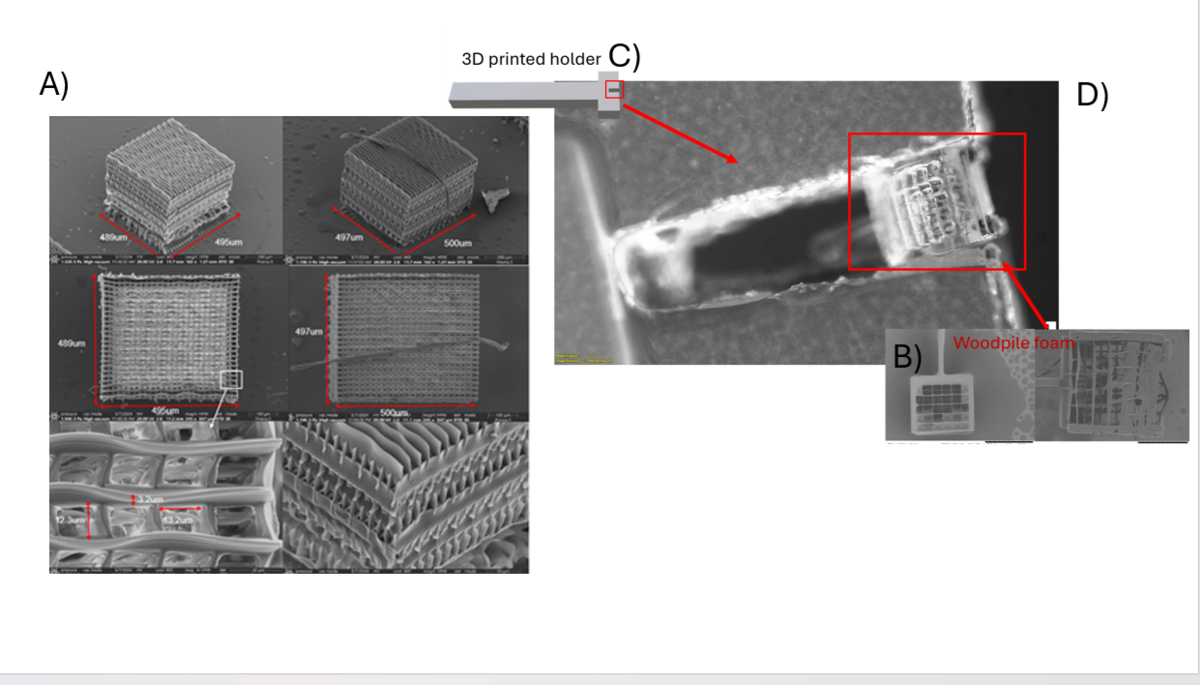
The main goal of this work was to use a femtosecond laser to fabricate high-porosity woodpile foams from acrylate materials (Pentaerythritol triacrylate and Pentaerythritol tetraacrylate), optimizing both the laser writing speed and power. This study marks the first time a green laser has been used on these materials. After fabrication, the woodpile structures were integrated into a 3D-printed holder, for investigation for ICF, which will take place in ABC group of ENEA center in Frascati.
Figure 1 presents the process of integrating the foams into the holder. First, the woodpiles were fabricated. Next, the porosity was increased, and a thin wall was added around the woodpile to enhance rigidity. A 3D-printed holder was then created. Finally, the woodpile was mechanically inserted into the holder.