
Ultra-short pulsed lasers featuring high average power and energy good quality beams are widely used for pumping optical parametric chirped pulse amplifiers (OPCPA), generation of X-ray radiation or material processing utilizing interference patterning and many other. Yb:YAG has a range of properties suitable for high-power diode-pumped solid-state (DPSS) lasers, such as low quantum defect, high heat conductivity, long fluorescence lifetime, high tensile strength, etc. These properties allow Yb:YAG based lasers to reliably generate powerful good quality beams [1]. Amplification of laser beams using isotropic materials, such as YAG or laser glasses suffers from thermal effects, such as thermal lensing, birefringence and depolarization which are most prevalent in high intensity lasers. These effects can degrade beam parameters and cause undesired losses. A classical end-pumped rod-type amplifier configuration offers high optical to optical amplification efficiency but greatly suffers from thermal effects and as a result requires extra steps to achieve required beam parameters [2]. In this work the thermal effects and methods to control them in high average power end pumped rod type Yb:YAG laser amplifiers are discussed and resultant beam parameters are investigated in our high repetition rate hybrid laser system.
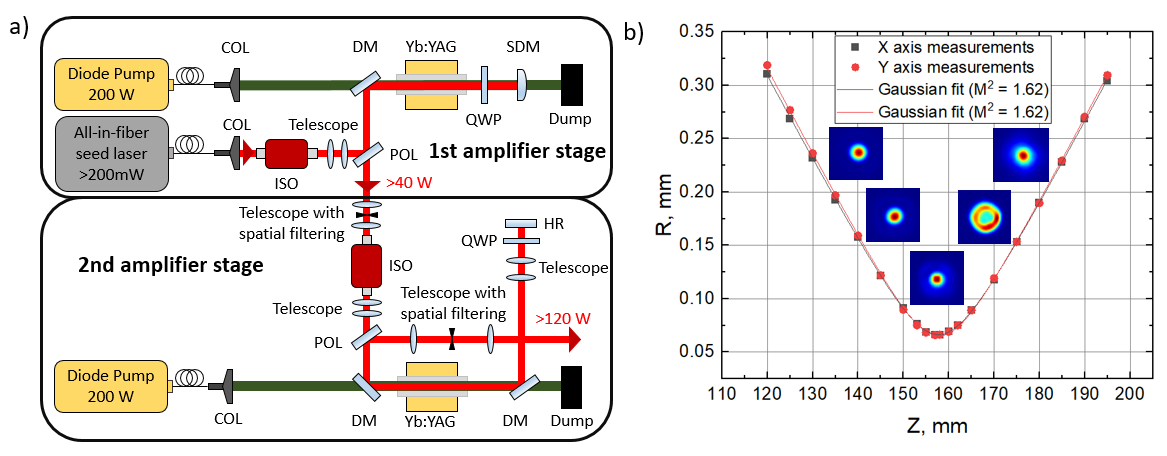
A master oscillator power amplifier (MOPA) laser system, which consists of a fiber seed source and two stages of free-space end-pumped double-pass Yb:YAG rod amplifiers was investigated. The system produced 100 ps stretched pulses at >120 W average power and 100 kHz – 1 MHz pulse repetition rates. The depolarization losses (7-8 %) in the laser system were quite moderate. The output beam profile was affected primarily by gain saturation, which resulted in a reduced beam quality parameter, M2 ≈ 1.6 (Fig. 1.). A spatial filtering scheme was employed to significantly improve the beam quality reaching almost the diffraction limit (M2 ≈ 1.05) at the cost of the moderate losses of 10.7 %. It is apparent that increased thermal load on the active medium, has a significant influence on the beam parameters. At high pumping power depolarization can cause severe losses and in addition degrade the beam profile further highlighting the importance of depolarization compensation.