Scots pine (Pinus sylvestris) is one of the most common and highly valued tree species in the Baltics. Nurseries and young stands of Scots pine are highly susceptible to needle cast disease caused by fungi Lophodermium seditiosum Minter, Staley and Millar, which affects the growth and survival of saplings negatively and makes them more prone to other biotic factors [1].
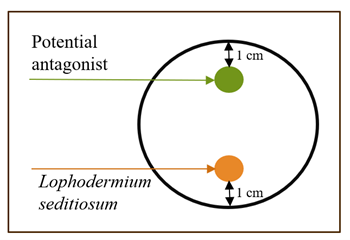
Research was conducted to find an environmentally safe way to protect younger Scots pine saplings from premature needle cast caused by L.seditiosum. For this purpose, endophytic fungi were isolated from mature Scots pine trees located in Juodkrantė Forest, and their antagonistic potential was tested under in vitro conditions. In total, 62 endophytic fungi were extracted by using five different growth mediums to achieve maximum diversity of fungi. To check if endophytes were natural antagonists of needle cast, an in vitro dual culture study was conducted: a pathogen and possible antagonist were placed in a Petri dish and their interaction was observed [2] for 5 weeks (Fig. 1). It was found that only 13% of fungi slowed down or completely stopped the growth of L.seditiosum by 30% during all 5 weeks of the experiment. Six endophytic fungi were discovered to inhibit the growth of the pathogen by 60% or more, and they will be chosen for further investigations in field experiments, where Scots pine saplings will be treated with antagonists to prevent the needle cast disease.