
Hybrid perovskite light-emitting diodes (PeLEDs) are a promising new technology for the development of next-generation light sources. They are characterized by high photoluminescence (PL) and electroluminescence (EL) efficiency, which is now above 30%. In some applications, PeLEDs are expected to operate in pulsed mode. Generation of light pulses with sufficiently high intensity requires high power electrical pumping, which poses significant problems for electrical pumping and leads to deterioration of PeLED performance, its degradation or even damage. PeLEDs operating in a non-conventional regime based on the so-called overshoot effect enable generation of short, high intensity, perfectly electrically synchronizable optical pulses by using relatively low-power electrical pumping. 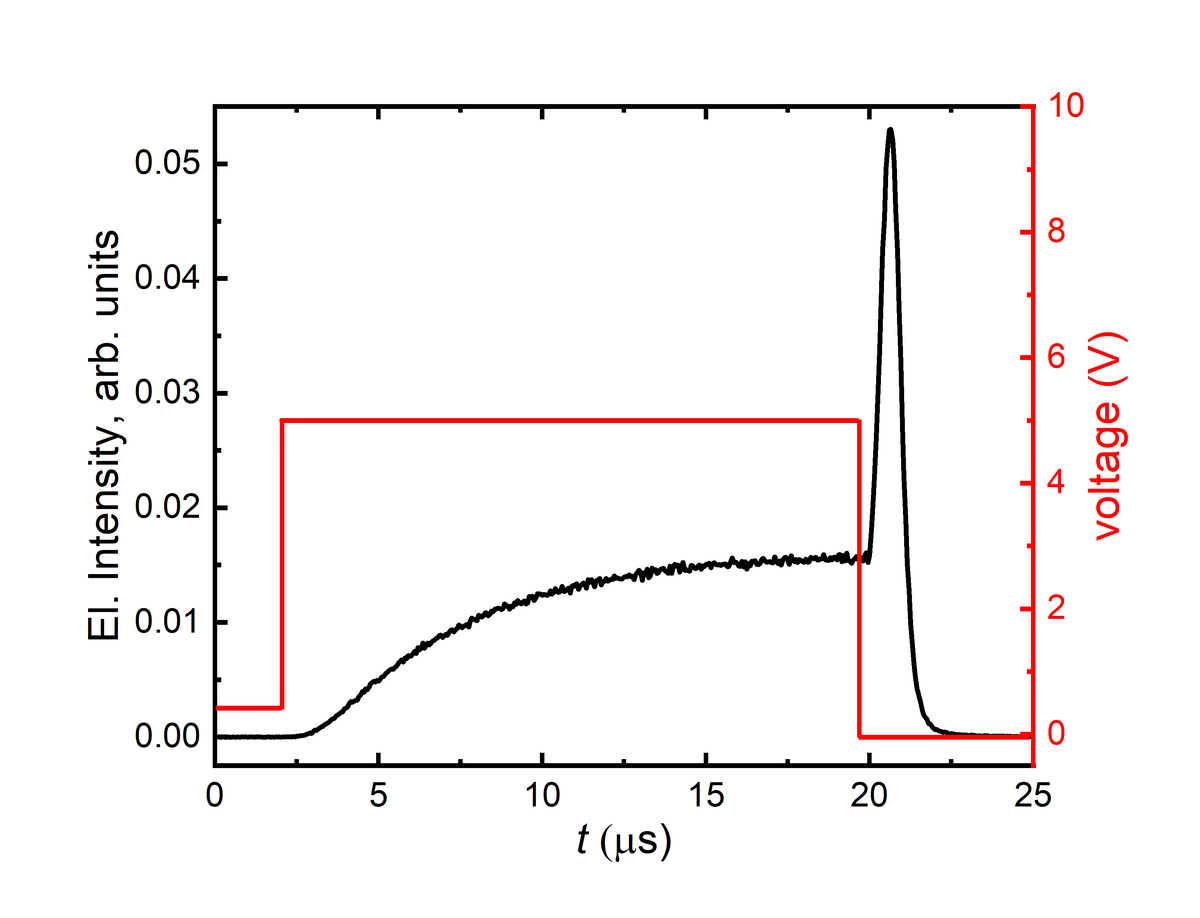
OVERSHOOT PULSES IN PEROVSKITE LIGHT EMITTING DIODES. THE ROLE OF OPERATION CONDITIONS
Ignas Ledzinskas1, 2, Rokas Gegevičius1, Vidmantas Gulbinas1
1 Department of Molecular Compound Physics, Center for Physical Sciences and Technology
2 Faculty of Physics, Vilnius University
Fig. 1. Electroluminescence overshoot transient after application of rectangular voltage pulse (red).