Electric propulsion systems, such as Hall Effect Thrusters (HET), are widely used in space missions due to their high efficiency and performance, replacing chemical thrusters, which are highly limited by their operating time and working principles. Thus, manufacturers are seeking to maximize payload space and lower costs—driving research into miniaturization. Traditional xenon propellant, stored in large pressurized tanks, is costly and limited on Earth, prompting the search for alternatives[1].
In this particular study, we analyze how miniaturization of HET is possible through using pure bismuth as a novel propellant, it’s sustainability for use in future space missions and determine miniatiurization’s implications for the thruster.
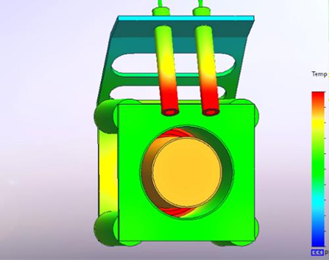
To find out if bismuth can be a feasible option for use in miniaturized propulsion systems, which might seem like a daunting task at first due to the sheer number of processes involved, two different software tools were used in combination to compile a numerical model of HET. The model was simplified to reduce computational time while maintaining the essential physical processes. Thermal simulations were conducted to analyze temperature changes during ionization. Using CST Studio Suite, heat loss data from electron and ion collisions was imported into Solidworks FLOW/THERMAL, where direct solar heating, thermal loads, and radiation were applied for representative results. Literature investigation on the implications of miniaturization[2] was combined with numerical studies, and a verdict on feasibility was provided.
Gained data shows that most of the heat losses caused by wall collisions occur in the inner channel of the 250 W HET, meaning that this zone will be prone to the most erosion - notable point of failure in HETs[3]. Thermal simulations reveal that the inner channel edges of the engine heat up to around 650°C and inner magnetic cores up to 350°C after just one hour from a “cold start”. At such temperatures, soft iron cores will approach their Curie temperature of 770°C and lose their magnetic abilities, instantly compromising the operation of the HET[4]. This is mainly caused by the additional mechanisms required to vaporize bismuth (according to calculations, 50-100 watts of heating power is required). Optimizing these mechanisms and utilizing parasitic heat losses could eliminate the need for pressurized tanks, saving up to 33% of payload space - enabling a miniaturized, sustainable propulsion system.
From this study, considering the demand for space sustainability and miniaturization from a growing number of satellites in LEO and despite higher operational temperatures with Bi, its cost-effectiveness, space savings, better thrust-to-power ratio, and availability as a resource on Earth, demand it’s recognition as a viable propellant for the future.