Ceramics play a huge part in nowadays life due to wide range of applications – from dielectrics in capacitors to piezocalipers, memory elements, and sensors. Phosphate-bonded ceramics (PBCs) are perspective alternative to conventional ones or produced by means of complicated and energy-intensive methods as spark plasma sintering or hot pressing. PBCs are eco-friendly, demonstrate outstanding thermal, chemical and mechanical stability. One of sufficient drawbacks of such ceramics is relatively lower density in comparison to their conventionally made counterparts. In this report, we research and ways to improve the properties of these ceramics by means of optimization of the preparation technique.
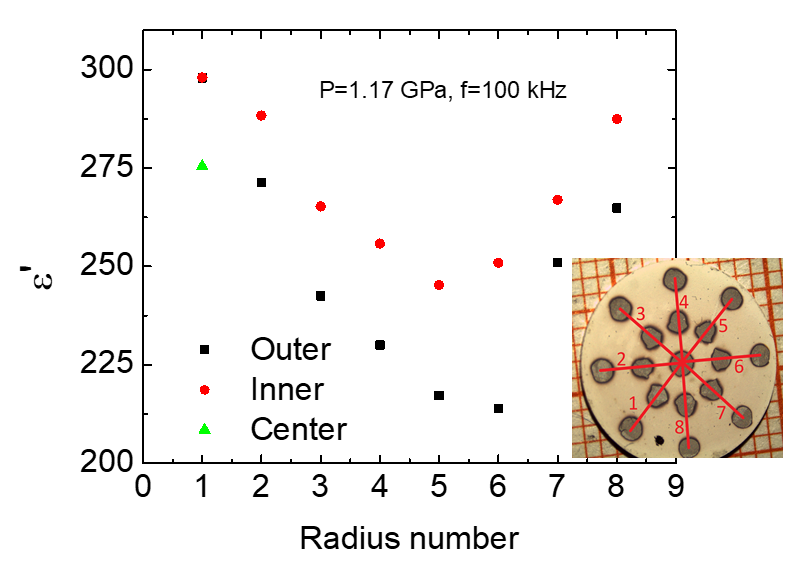
The phosphate binder was prepared by dissolving AlPO4 in water until the density of this mixture reached 1,40 g/cm2. 1,5 g of barium titanate where homogenized with 8,5 % of binder and pressed into pellets under 86,7 MPa, 173,3 MPa, 260,2 MPa, 347 MPa, 520 MPa, and 693,9 MPa. Two series of samples were produced – one with mean grain sizes of 700 nm and one with 300 nm. Afterwards, the produced tablets were left to cure for 24h and heated up in a furnace at 300 C for 1h. In order to explore the planar distribution of density (or dielectric permitivitty), one side the tablet was coated fully with silver contact via vapor deposition and on the other side a constellation of co-radial contacts was applied (see fig. 1).