Kristina Radinović1, Jadranka Milikić1, Ana Nastasić2, Katarina Rondović1, Ljiljana Damjanović-Vasilić1, Aldona Balčiūnaitė3, Vladislav Rac4, Rastko Vasilić5
1 University of Belgrade, Faculty of Physical Chemistry, Studentski trg 12-16, 11158 Belgrade, Serbia
2 Department of Nuclear and Plasma Physics, Vinča Institute of Nuclear Sciences – National Institute of the Republic of Serbia, University of Belgrade, P.O. Box 522, 11001 Belgrade, Serbia
3 Center for Physical Sciences and Technology, Saulėtekio Ave. 3, Vilnius LT-10257, Lithuania
4 Faculty of Agriculture, Department of Chemistry, University of Belgrade, Nemanjina 6, 11080 Zemun, Serbia
5 University of Belgrade, Faculty of Physics, Studentski trg 12-16, 11000 Belgrade, Serbia
Zeolites, also known as crystalline aluminosilicates, are characterized by their large specific surface area, porosity, and easy incorporation of cations, which makes them attractive materials for use in electrocatalysis [1,2]. Therefore, this group of materials can be used for the oxygen reduction reaction (ORR) as there is a trend of the world transitioning to green energy sources in an increasingly demanding effort to protect the environment [3,4].
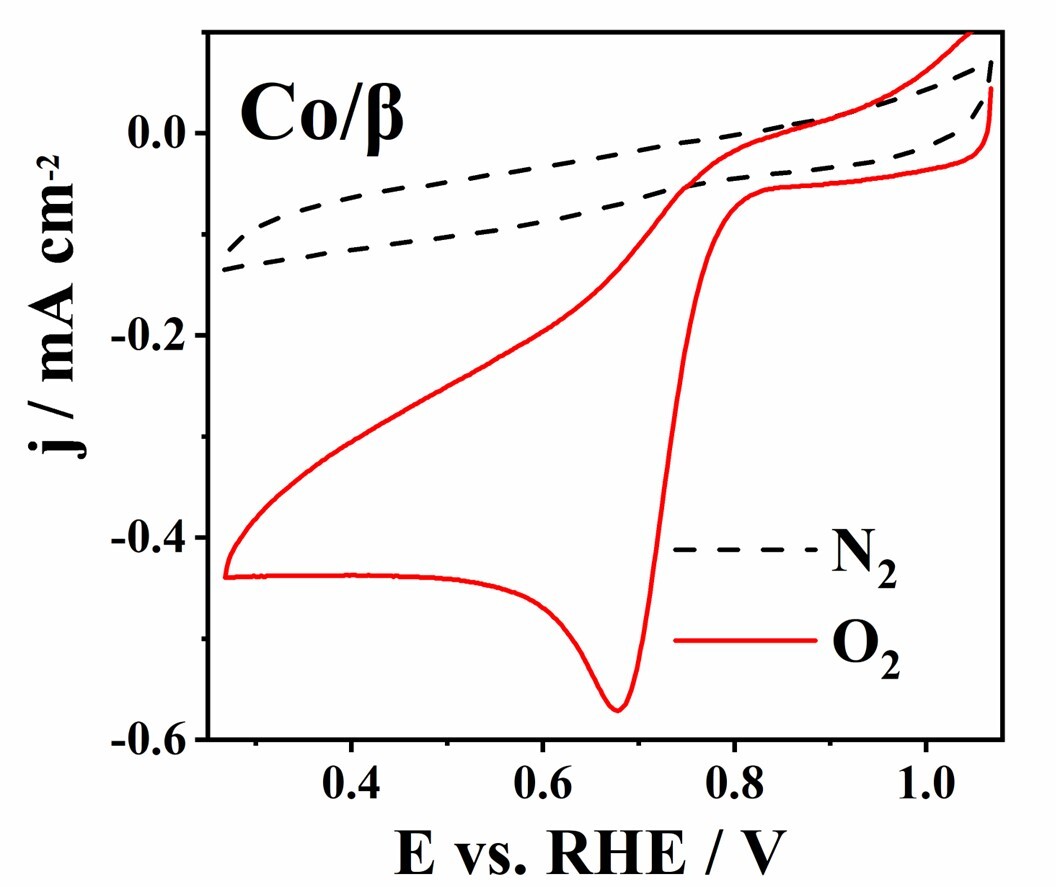
In this work, β zeolite was synthesized in combination with the transition metal cobalt (Co), and as such was tested for activity towards ORR. Namely, the electrocatalytic activity was tested in N\(_{2}\)- and O\(_{2}\)- saturated 1 M KOH solution at 20 mV s\(^{-1}\), using cyclic voltammetry (CV).
Fig. 1. CVs (cathodic scan) of Co/β at 20 mV s−1 in N2- and O2- saturated 1 M KOH solution.
As can be seen from Fig. 1, a clearly defined characteristic peak for ORR is observed at a potential of 0.68 V with a current density of about -0.60 mA cm\(^{-2}\). On the other hand, the current density in N\(_{2}\) was about -0.06 mA cm\(^{-2}\), confirming the activity of Co/β zeolite for ORR, which further implies that the synthesized zeolite may represent a potentially good catalyst for application in fuel cells and batteries.
[1] J. Milikić, S. Stojanović, L. Damjanović-Vasilić, R. Vasilić, L. Rakočević, S. Lazarević, B. Šljukić, Porous cerium-zeolite bifunctional ORR/OER electrocatalysts in alkaline media, J. Electroanal. Chem. 944 (2023). https://doi.org/10.1016/j.jelechem.2023.117668
[2] J. Milikić, S. Stojanović, L. Damjanović-Vasilić, R. Vasilić, B. Šljukić, Efficient bifunctional cerium-zeolite electrocatalysts for oxygen evolution and oxygen reduction reactions in alkaline media, Synth. Met. 292 (2023) 1–10. https://doi.org/10.1016/j.synthmet.2022.117231.
[3] J. Milikić, A. Nastasić, M. Martins, C.A.C. Sequeira, B. Šljukić, Air Cathodes and Bifunctional Oxygen Electrocatalysts for Aqueous Metal–Air Batteries, Batteries. 9 (2023) 394. https://doi.org/10.3390/batteries9080394.
[4] K. Radinović, D. Mladenović, J. Milikić, M. Alsaiari, F.A. Harraz, D.M.F. Santos, B. Šljukić, Tuning Electrocatalytic Activity of Gold Silver Nanoparticles on Reduced Graphene Oxide for Oxygen Reduction Reaction, J. Electrochem. Soc. 169 (2022) 054501. https://doi.org/10.1149/1945-7111/ac67b7.