Additive manufacturing has garnered significant attention in both industrial and commercial applications. One of its key techniques, stereolithography, utilizes UV light to fabricate complex 3D structures from UV-curable photoresins. For this process, homogeneous resins are preferred over multiphase resins, as the latter can lead to sedimentation and light scattering, compromising the uniformity of the printed objects. Ensuring uniformity enhances mechanical properties, improves surface finish, and minimizes defects during polymerization and subsequent heat treatment. Moreover, combining stereolithography with pyrolysis—a high-temperature treatment in a non-oxidizing atmosphere—enables the fabrication of ceramic 3D objects.
Hexagonal boron nitride (h-BN) is known for its chemical inertness, corrosion resistance, low density, and high thermal stability. Incorporation carbon into the h-BN lattice reduces its bandgap, making it a semiconductor with potential applications in photocatalysis [1]. When exposed to light, semiconductor materials accelerate photoreactions, a process known as photocatalysis, which can be applied to water treatment by degrading non-biodegradable organic pollutants. Unlike conventional methods, this photocatalytic approach eliminates the need for an additional purification step to remove reactants and by-products after treatment.
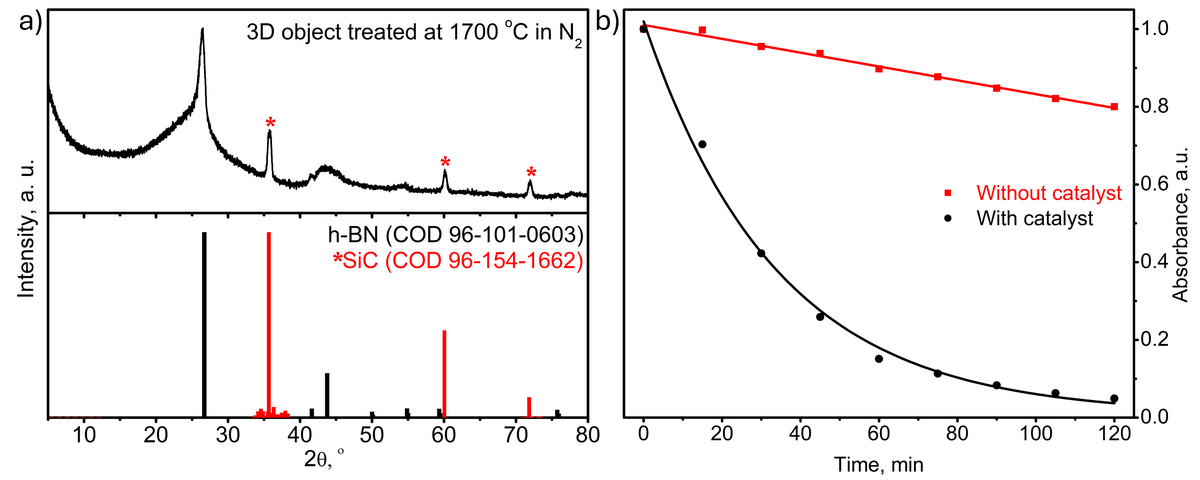
In this study, the boron-containing organic monomer 2-(5,5-dimethyl-1,2,3-dioxaborinan-2-yloxy)ethyl methacrylate (BoMA) was synthesized via esterification reaction as described in [2]. The successful synthesis of BoMA was confirmed by proton nuclear magnetic resonance analysis, achieving a product yield of approximately 70%. Subsequently, BoMA was employed in the fabrication of 3D-printed objects using UV-based stereolithography system Zortrax Inkspire. The printed 3D objects were then subjected to pyrolysis at 1000 oC in vacuum and later at 1700 oC in N\(_2\) atmosphere. X-ray diffraction (XRD) analysis confirmed the formation of the h-BN phase (Figure 1a). Additionally, the photocatalytic activity of the fabricated ceramic structures was evaluated through rhodamine B degradation under halogen lamp simulating sunlight, confirming their efficiency as photocatalysts (Figure 1b).
This study demonstrates that the combination of organoboron methacrylate synthesis, stereolithography, and pyrolysis provides a viable approach for fabricating photocatalysts capable of degrading organic pollutants in water under solar irradiation.