Treatment for chronic pain consists of opioids and NSAIDs, which can cause health issues on their own.[1] The topical application of capsaicin is a promising milder alternative. However, due to concerns about the effectiveness and associated risks of long-term use of capsaicin [2-4], a polymer-based drug delivery system (DDS) may help address these issues. Our objective was to design and explore a polymer-based drug delivery system for the topical application of capsaicin.
To achieve this goal, we first extracted capsaicin from chili peppers using vegetable oil. The oil infused with capsaicin (CapOil) was then embedded into a polypyrrole (PPy) matrix, which was further fused together and stabilized with polyaniline (PANI).
Capsaicin was released from the produced system using chronoamperometry. The release characteristics of the system were analyzed with spectrometry, Chrono Amperometry (CA) and Pulsed Chrono Amperometry (PCA).
We were able to design a functioning DDS system based on a polymer matrix with inserted capsaicin.
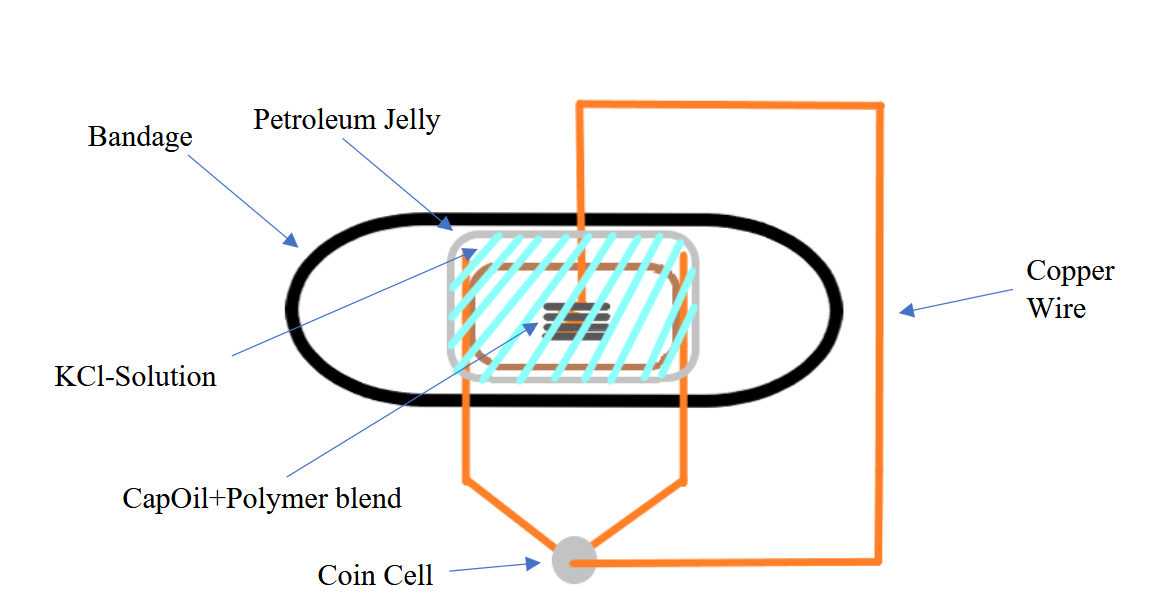
The ratio of polymer to analyte was optimized to 30vol% of CapOil. The best release potential was determined to be 1.75V. A long-term PCA measurement showed that the system reacts predictable to applied potential after an initial 10min delay. Based on these findings we were able to design and build a prototype (see Figure 1).
The gathered results show that a polymer-based DDS in combination with capsaicin is viable. With further research these systems could be developed into a product.