
Oral diseases are a pressing health problem worldwide. Their characteristic features are infections caused by microorganisms, inflammatory processes and tissue degradation. Hydrogels, due to their unique characteristics, have gained great importance in modern dentistry [1]. Their three-dimensional structure, high water content, biocompatibility and various biological properties make them suitable for use as drug delivery systems, antimicrobial agents, matrices for tissue regeneration and biosensors. Due to the resistance of many microorganisms to synthetic drugs, the use of dosage forms with plant extracts is relevant [2].
The work investigated the possibility of obtaining PVA hydrogels based on aqueous extracts of nettle, chamomile and oak bark by cryostructuring with the addition of starch (St) and carboxymethylated starch (CMS) in a 1:1 ratio. It is known that PVA forms a spatial structure of hydrogels upon thawing, and St and CMS upon freezing. It was found that all the studied phytohydrogels form stable structures, which were studied for their sorption properties in relation to the action of distilled water and physiological NaCl solution [3, 4]. All hydrogels reach an equilibrium value of the degree of sorption within 3-4 hours. The value of the equilibrium degree of sorption depending on the composition and type of plant extract is shown in the Figure 1. 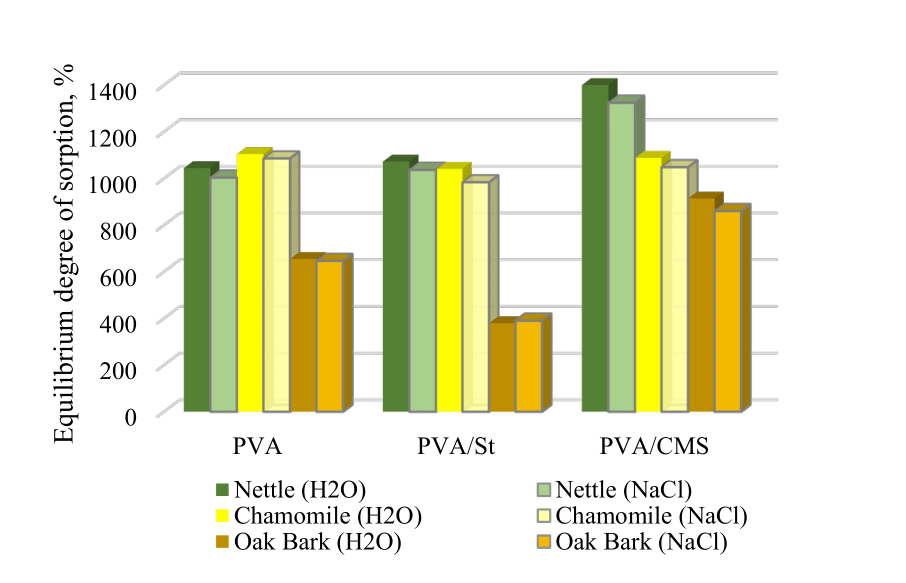
It was found that the addition of CMS increases the equilibrium degree of sorption for samples based on nettle extract and oak bark by 1.47 and 1.39 times, respectively. For hydrogels based on chamomile extract, the equilibrium degree of sorption decreases with the addition of St by 1.06 times, and with the addition of CMS by 1.01 times. Thus, taking into account the values of the equilibrium degrees of sorption, it is advisable to continue research in the direction of determining the nature of the release of active ingredients of plant extracts to establish the effectiveness of the use of hydrogels in dentistry.