
Axial-mode helix antennas, where the circumference of the helix is approximately equal to the operating wavelength, are highly valued for their directional radiation patterns, high gain, and wide operational bandwidth. Dielectric loading is a well-established technique for antenna miniaturization, as it effectively slows wave propagation and reduces the physical size of the structure. However, the effects of dielectric loading on the radiation characteristics, efficiency, and bandwidth of helix antennas have not been thoroughly investigated.
We investigated dielectric loaded helix antenna in order to observe how the insertion of a dielectric material affects the operational frequency of the helix. During the work it was discovered that increasing the dielectric permittivity of the material inside the helix not only reduces the antenna dimensions, but also degrades the antenna’s gain, axial ratio, and radiation characteristics. We hypothesize that this degradation results from a suboptimal pitch angle. In a helix antenna interaction between turns allows for constructive interference of the radiated waves along the axis of the helix. When the electromagnetic field is disturbed by the inserted dielectric material, it is likely that the optimal pitch angle also changes. To investigate the dependence of the optimal pitch angle on the dielectric permittivity of the inserted material, we performed electromagnetic simulations in CST Studio. In the picture (Fig. 1) we see electric field in y0z plane radiated by the helix antenna at different conditions. We observe that, at the optimal pitch angle and frequency (Fig. 1 A, B), the fields generated by each winding interfere constructively, producing a directional beam with high gain. However, under non-ideal conditions the running wave pattern is disrupted, and the fields from each winding interfere destructively, leading to scattered radiation. 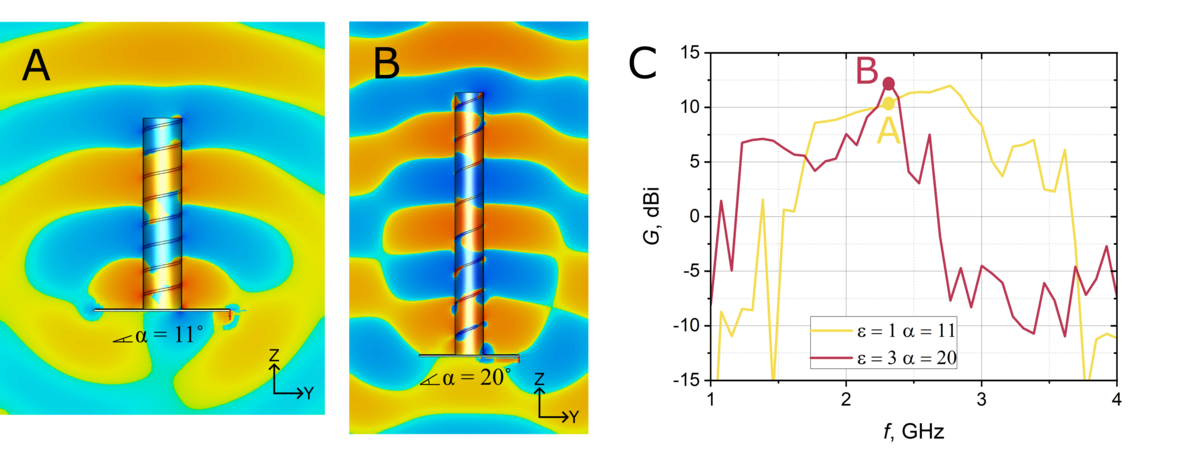
To further investigate this phenomenon, we analyse fields and currents induced by helix under varying conditions to confirm the optimal parameters for constructive interference along the helix axis. To confirm our findings, we manufactured dielectric loaded helix antenna using a novel SSAIL (selective surface activation by laser) technique, that allows growing metallization on wide range of dielectric materials. Antennas are measured, and their results are compared to simulated data.
Reducing helix size using high dielectric permittivity dielectrics without degrading radiation characteristics would make it highly suitable for a wide range of telecommunications applications or space communication systems where weight, size, and performance are critical constraints.