Ana Nastasić1, Jadranka Milikić2, Kristina Radinović2, Katarina Rondović2, Ljiljana Damjanović-Vasilić2, Aldona Balčiūnaitė3, Vladislav Rac4, Rastko Vasilić5
1 Department of Nuclear and Plasma Physics, Vinča Institute of Nuclear Sciences – National Institute of the Republic of Serbia, University of Belgrade, P.O. Box 522, 11001 Belgrade, Serbia
2 University of Belgrade, Faculty of Physical Chemistry, Studentski trg 12-16, 11158 Belgrade, Serbia
3 Center for Physical Sciences and Technology, Saulėtekio Ave. 3, Vilnius LT-10257, Lithuania
4 Faculty of Agriculture, Department of Chemistry, University of Belgrade, Nemanjina 6, 11080 Zemun, Serbia
5 University of Belgrade, Faculty of Physics, Studentski trg 12-16, 11000 Belgrade, Serbia
The development of novel, efficient enough, more stable and low-cost electrocatalysts for the oxygen reduction reaction (ORR) is one of the crucial obstacles to the commercialization of fuel cells and metal-air batteries, i.e. the world’s transition to green zero-carbon energy sources and solving the energy supply problem [1,2]. Crystalline aluminosilicates, better known as zeolites, have a unique structure that makes them suitable as active matrix in electrocatalysis, namely: exceptional ion exchange capacity, high adsorption, and large specific surface area [3-5].
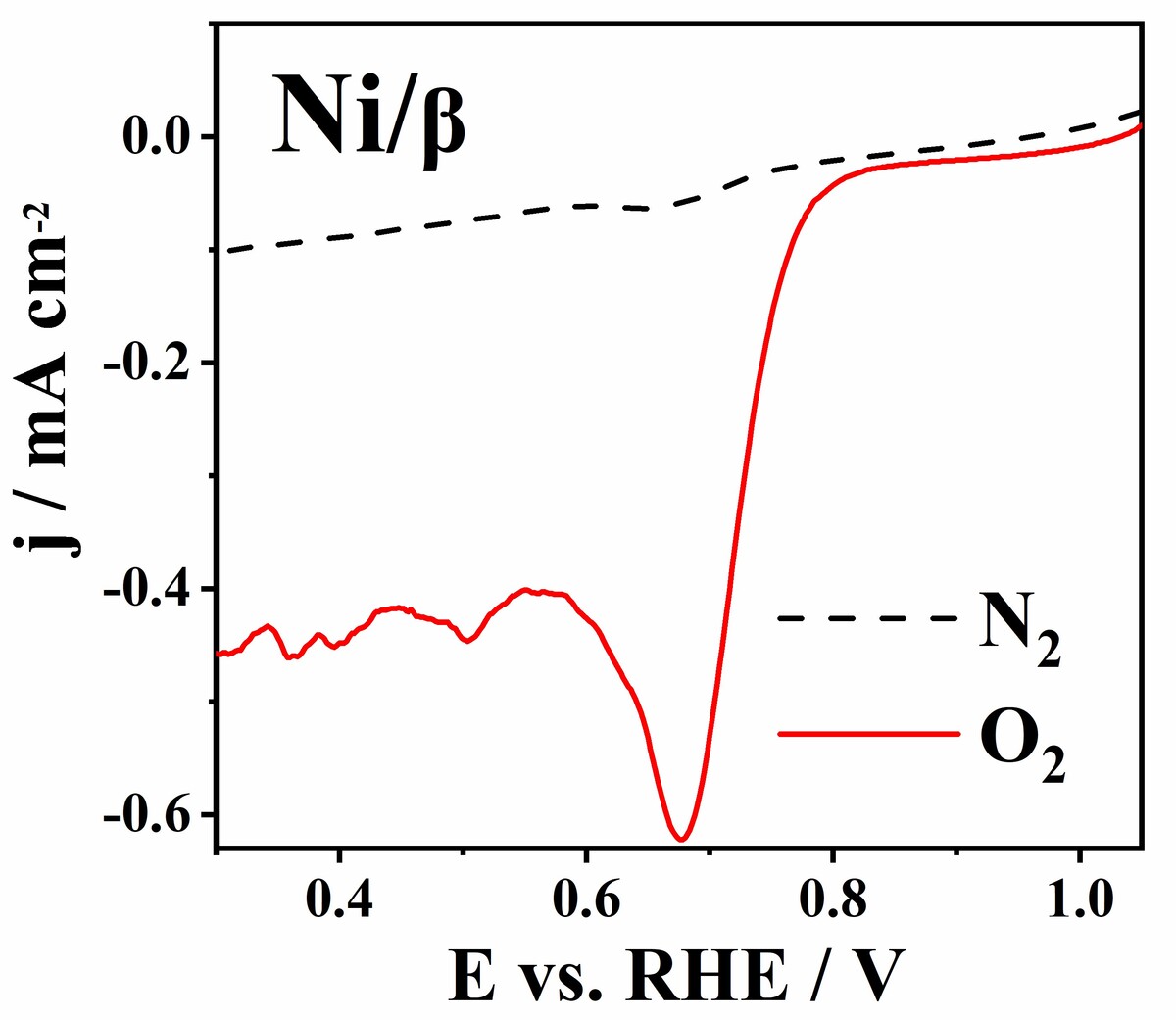
Herein, β zeolite was combined with the transition metal nickel (Ni) that shows promising stability and activity in the field of electrocatalysis. The electrocatalytic activity of the obtained material (Ni/β) towards ORR was examined in N\(_{2}\)- and O\(_{2}\)- saturated 1 M KOH solution by cyclic voltammetry (CV) (Fig. 1).
Fig. 1. CVs (cathodic scan) of Ni/β at 20 mV s−1 in N2- and O2- saturated 1 M KOH solution
A characteristic ORR peak was observed at a potential of 0.68 V vs. RHE in an O\(_{2}\)- saturated solution. Slightly more than ten times higher current density at this potential in an O\(_{2}\)- saturated solution, compared to the current density observed in a N\(_{2}\)- saturated solution, leads to the conclusion that Ni/β zeolite is active towards the ORR and that it could be potentially good replacement for costly benchmark platinum-based electrocatalysts. A.N. acknowledge support provided by the Vinča Institute of Nuclear Sciences, through Contract No. 451-03-136/2025-03/ 200017 with the Ministry of Science, Technological Development, and Innovation of the Republic of Serbia.
[1] J. Milikić, A. Nastasić, M. Martins et al., Air Cathodes and Bifunctional Oxygen Electrocatalysts for Aqueous Metal–Air Batteries, Batteries 9, 1-24 (2023).
[2] J. Milikić, A. Nastasić, S. Knežević et al., Efficient nano-size ZnM/rGO (M = Ni, Cu, and Fe) electrocatalysts for oxygen electrode reactions in alkaline media, International Journal of Hydrogen Energy 97, 247-258 (2025).
[3] J. Milikić, S. Stojanović, L. Damjanović-Vasilić et al., Porous cerium-zeolite bifunctional ORR/OER electrocatalysts in alkaline media, Journal of Electroanalytical Chemistry 944, 117668 (2023).
[4] J. Milikić, S. Stojanović, L. Damjanović-Vasilić et al., Efficient bifunctional cerium-zeolite electrocatalysts for oxygen evolution and oxygen reduction reaction in alkaline media, Synthetic Metals 292, 117231 (2023).
[5] X. Wei, Y. Li, Z. Hua et al., One-Pot Synthesized Nickel-Doped Hierarchically Porous Beta Zeolite for Enhanced Methanol Electrocatalytic Oxidation Activity, ChemCatChem 12, 6285-6290 (2020).