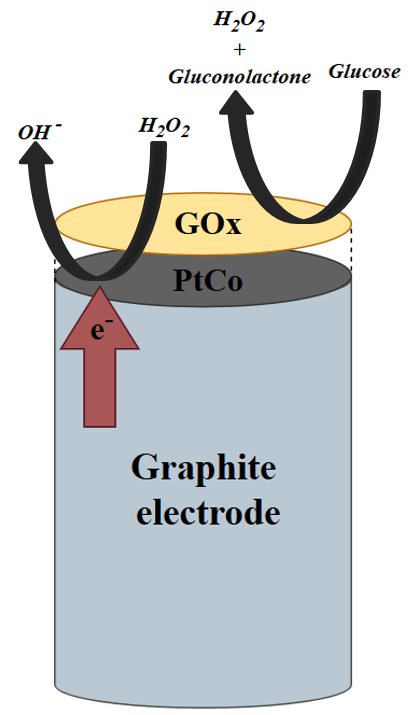
Determination of glucose concentration is very important for people with diabetes. By monitoring blood glucose levels, these individuals can make informed decisions about medication, diet and lifestyle, thereby reducing the risk of diabetes complications. There are many ways to determine the concentration of glucose, but amperometric biosensors, whose operation is usually based on the oxidation of glucose catalyzed by immobilized glucose oxidase (GOx), are the most common object of research due to their extremely simple operating principle. In addition, they are highly sensitive and selective for glucose, have a short response time, and do not require additional sample preparation.
In order to increase the sensitivity and selectivity of biosensors and reduce the effect of interfering substances on the analytical signal, nanomaterials are being implemented. Currently, nanozymes - nanomaterials imitating the catalytic activity of enzymes - are attracting a lot of attention from scientists. Unlike natural enzymes, they are resistant to denaturation and are less sensitive to environmental changes such as temperature or pH. Nanozymes provide greater catalytic stability, easy modification, and lower production costs because they can be synthesized in simpler ways than natural enzymes, which often require extraction and purification. In addition, nanozymes also have properties characteristic of nanomaterials. Among the first nanozymes to be used in the construction of biosensors were Prussian blue nanoparticles that play the role of "artificial peroxidase" and catalyze the reduction of hydrogen peroxide.
In this work, seven different nanozymes were investigated and an amperometric glucose biosensor was developed using PtCo nanoparticles and GOx. The developed biosensor had a linear range of 0,04 – 2,18 mM glucose, a sensitivity of 1,42 μA/mM, and a detection limit of 0,032 mM. The biosensor was selective for glucose and its performance was not affected by interfering substances commonly found in biological samples. Thus, the obtained results suggest that the developed biosensor has potential to be used for glucose analysis, without interference from other substances. In addition, it had good stability over a period of 14 days.