A backward wave optical parametric oscillator (BWOPO) converts pump radiation into longer-wavelength signal and idler waves propagating in opposite directions, enabling mirrorless oscillation. Unlike conventional optical parametric generators and amplifiers, BWOPOs produce much narrower spectral widths and maintain stable wavelengths despite temperature changes [1]. Developing a model for BWOPOs is essential for optimizing design parameters, predicting performance, and understanding nonlinear dynamics without costly experiments. However, existing models are exclusively one-dimensional (1D), limiting their ability to capture spatial effects and more complex interactions [2,3]. Here, we propose a three dimensional (3D) model for a BWOPO in a periodically poled KTiOPO\(_4\) (PPKTP) crystal pumped by subnanosecond pulses from a Nd:YAG microlaser.
To model this system, we use three-wave coupling equations that account for beam diffraction, temporal walk-off, nonlinear coupling, and both linear and two-photon absorption. By numerically solving them using the split-step method, we can track the evolution of wave amplitudes throughout the interaction region.
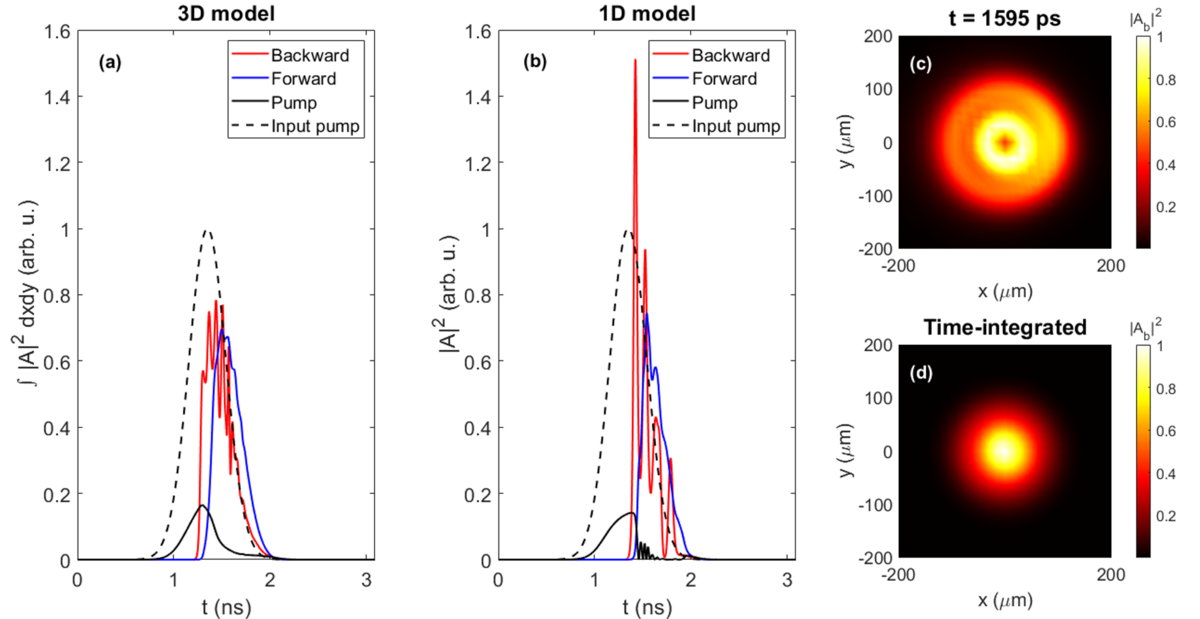
As shown in Fig. 1a, the 3D model enables us to visualize smooth and well-structured temporal profiles of the pump and generated pulses, closely resembling real experimental results. In contrast, the 1D simulation (Fig. 1b) exhibits highly oscillatory behaviour. The presence of off-axis components in the 3D model leads to the formation of ring-shaped beams (Fig. 1c), which become hidden when the beam profile is time-integrated (Fig. 1d). Our analysis reveals that this ring-shaped structure originates from X-wave formation within the nonlinear crystal. The sign of an X-wave’s propagation velocity is determined by the wavelengths of the generated waves, allowing it to travel either toward the crystal’s end or its front.
In conclusion, the proposed BWOPO model surpasses the limitations of previous 1D approaches and effectively demonstrates X-wave formation as a distinctive feature.