$ \(^{35}\)Cl AND \(^{37}\)Cl SOLID-STATE NMR STUDY OF CALCIUM CHLORAPATITE} Calcium phosphates (CaPs) are a family of materials used for various applications such as bone regeneration [1], catalysis, development of optical materials (LED), etc. CaPs are used in phosphorus-based LEDs for light conversion from higher to lower energies. Properties such as thermal stability, doping capabilities and photoluminescent properties are necessary for CaPs application in LED development [2].
In this study solid-state nuclear magnetic resonance (ssNMR) was used to characterize calcium chlorapatite (Ca\(_{5}\)(PO\(_{4}\))\(_{3}\)Cl, ClAp) samples with varying structural phases. ClAp samples were synthesized using molten salt synthesis method. Varying ratio of molten salts and treatment temperature we can control morphology of the samples. Furthermore, ssNMR of quadrupolar nuclei lets us probe the electronic environment at the site of nucleus of investigation. In this case, \(^{35}\)Cl and \(^{37}\)Cl ssNMR is used to determine number structural phases present in the samples and their dependance on synthesis parameters.
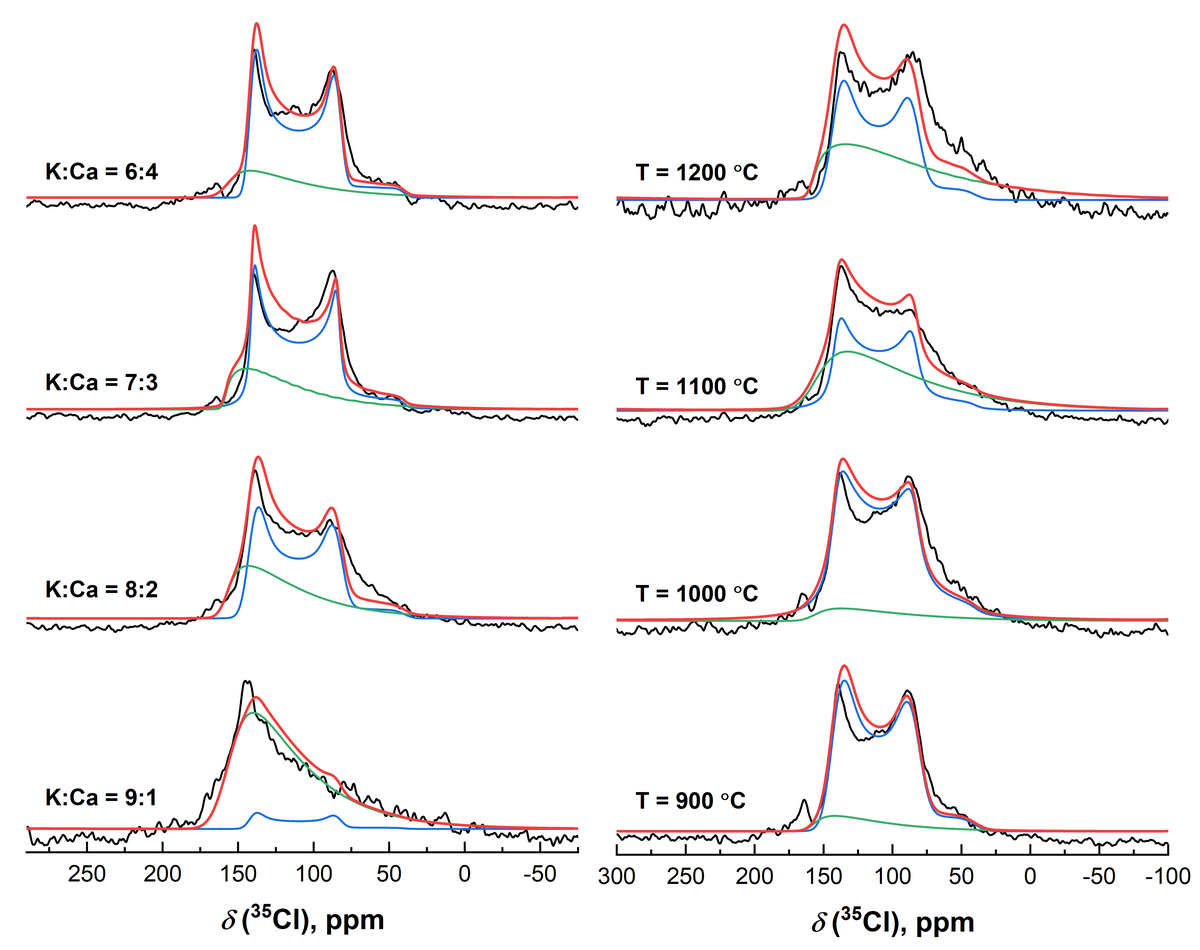
Fig. 1. 35Cl MAS NMR spectra of ClAp synthesized with (left) different molar proportions of molten salts (K:Ca = 9:1; 8:2; 7:3; 6:4, T = 750 °C, ACP:flux = 1:2, t = 5 h) and (right) varying treatment temperatures (T = 900; 1000; 1100; 1200 °C, K:Ca = 6:4, ACP:flux = 1:10, t = 5h).
It was found that the calcium chlorapatite samples contain crystalline and glassy type structural phases. Controlling the ratio of KCl and CaCl\(_{2}\) molten salts during synthesis influences formation of structural phases (increasing CaCl\(_{2}\) concentration increases concentration of crystalline phase). In contrast, treatment temperature used during synthesis influences disorder factor of glassy type structure (higher temperatures corelate with wider distribution of chlorine environments of glass structural phase).
[1] W. Habraken, P. Habibovic, M. Epple, and M. Bohner, “Calcium phosphates in biomedical applications: materials for the future?,” Materials Today, vol. 19, no. 2, pp. 69–87, Mar. 2016.
[2] Z. Zhang, J. Wang, M. Zhang, Q. Zhang, and Q. Su, “The energy transfer from Eu2+ to Tb3+ in calcium chlorapatite phosphor and its potential application in LEDs,” Appl. Phys. B, vol. 91, no. 3, pp. 529–537, Jun. 2008.