Magnesium chlorophyllin (Chl) is known as a semi-synthetic compound derived from chlorophyll, the green pigment. When exposed to light, Chl can act as a photosensitizer (PS) and has potential applications in medicine [1]. Additionally, studies have shown that this compound can function as an antioxidant in cancer cells [2]. Quantum dots (QD) can work together with photosensitizers and be used in medical diagnostics and therapy [3]. However, light is required to excite both PS and QD, so it is also important to evaluate their photostability. Whether photoexcited Chl will act as a PS or an antioxidant depends on the medium, in particular, on QD composition and/or structure.
The aim of this study was to investigate how QD of different compositions (CdTe-COOH (570 nm, PlasmaChem GmbH, Germany) , CuInZnS/ZnS-COOH (550 nm, Nanooptical materials, USA)) affect the spectroscopic properties of Mg-chlorophyllin, specifically optical density (OD) and fluorescence (FL), under irradiation. The concentrations of QDs were selected based on their fluorescence intensity to enable tracking of spectral changes over time. Samples of Mg-chlorophyllin with QDs in distilled water were irradiated at a distance of 8 cm using a 405 nm wavelength diode with a power of 30 mW/cm². The irradiation was applied on a 4x10 mm cuvette to a 1 cm² sample area. Changes in OD and FL were observed by increasing the irradiation doses, ranging from 1.8 J/cm² to 72 J/cm².
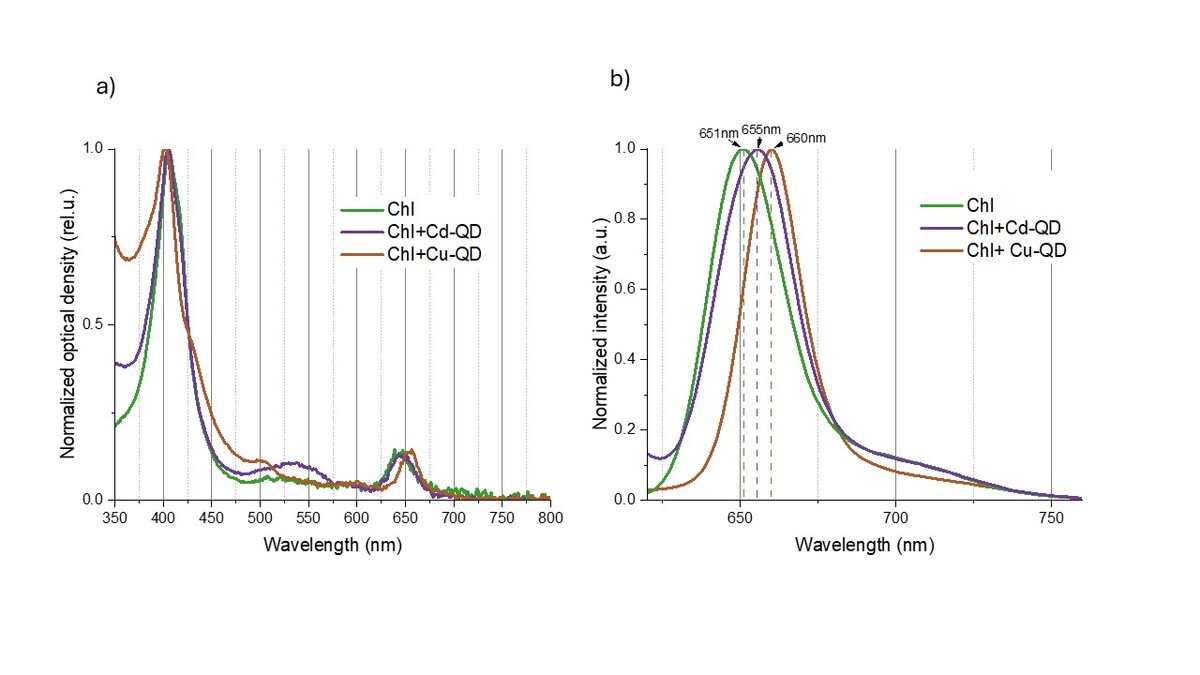
CuInZnS/ZnS-COOH QDs induced a greater bathochromic shift in the OD spectrum peak (from 645 nm to 655 nm) in distilled water immediately after sample preparation, while CdTe-COOH QDs shifted this peak to 647 nm (Fig. 1a). In the presence of QD, Chl FL peak shifted from 652 nm to 660nm or to 655 nm, respectively (Fig. 1b). In the absence of QDs, light exposure caused a decrease in Chl OD and FL intensity without any spectral shifts. The effect of light on Chl FL varied depending on the composition of the QDs in the medium. Under 18 J/cm² irradiation dose, CuInZnS/ZnS-COOH QDs caused a decrease in FL intensity and a further red shift of Chl FL band, whereas in the presence of CdTe-COOH QDs, no shift was observed.