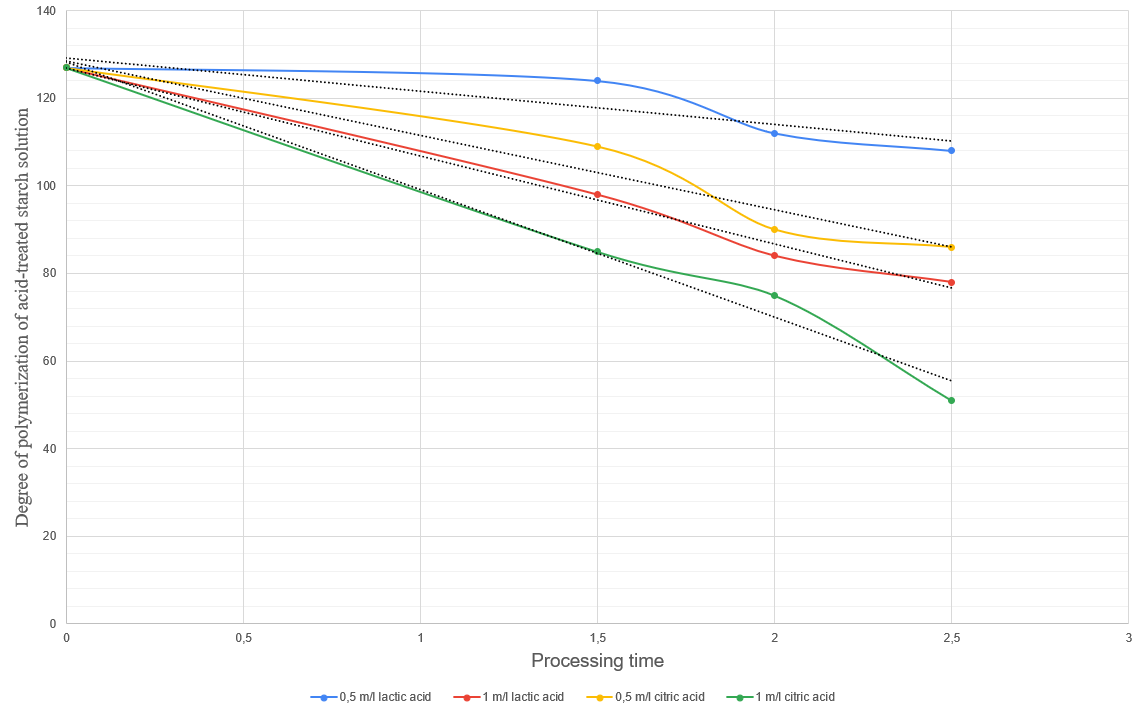
Starch modification is a significant research area in food technology and materials science. Acid treatment is a promising method that alters starch structure and properties, though its mechanisms require further study [1]. This study aimed to determine the effects of citric and lactic acid concentrations and treatment duration on the degree of polymerization (DP) of potato starch. Samples were treated with citric (1 mol/L, 0.5 mol/L) and lactic acid (1 mol/L, 0.5 mol/L) solutions for 1.5, 2.0, 2.5 hours at 60°C. After 24-hour settling, titration with 0.1 N NaOH was performed. DP was assessed viscometrically after dissolution in cadexomer, and predictive equations based on time (τ) and concentration (C) were developed: Citric acid: DP = 149.86 - 20.07⋅τ - 37⋅C; Lactic acid: DP = 209.33 - 23⋅τ - 76.67⋅C
Fig. 1. Fig 1.The graph of the dependence of the degree of polymerization on time and treatment concentration
Results showed that DP decreased from 127 to 51 with citric acid and from 127 to 78 with lactic acid. The interaction of carboxyl groups with the polysaccharide matrix influenced polymerization: citric acid (three carboxyl groups) formed ester bonds, promoting a network structure, while lactic acid (one carboxyl group) facilitated hydrolysis, shortening polymer chains [2]. Carboxyl groups initially present in the solution integrate into the starch structure, participating in branching and hydrolysis. As a result, fewer free polymer fragments remain in the solution, leading to a lower degree of polymerization. Analysis of the treatment solutions confirmed a decrease in carboxyl group concentration, indicating their incorporation into the starch structure. DP strongly depended on acid type, concentration, and treatment duration. Citric acid enhanced structural stability, whereas lactic acid led to greater chain cleavage. These findings enable precise control over starch properties for specific applications [3].
[1] Gerezgiher, A & Szabó, T. (2022). Crosslinking of Starch Using Citric Acid. Journal of Physics: Conference Series. 2315. 012036. 10.1088/1742-6596/2315/1/012036.
[2] Ishchenko, O., Kuchynska, D., Plavan, V. & Ostrauskaitė, J. Wound Dressings Films Based on the Citric Acid Modified Starch. The 10th International Conference on Advanced Materials and Systems (ICAMS 2024), 2024, Sciendo, pp. 101-106.
[3] Mohd Adnan, Ahmad Faris, Nishida Haruo, Shirai Yoshihito. (2008). Evaluation of kinetics parameters for poly(L-lactic acid) hydrolysis under high-pressure steam. Polymer Degradation and Stability. 93. 1053-1058. 10.1016/j.polymdegradstab.2008.03.022.