Green freshwater microalgae, commonly found in lakes, are easily cultivated and highly sensitive to environmental changes, making them excellent bioindicators. Their autofluorescence (AF) enables a safe, non-invasive monitoring of pollutants-induced effects in algae.
Quantum dots (QDs), which are becoming widely industrialized, are nanoscale semiconductor particles with unique optical properties, including bright photoluminescence (PL) which depends on their composition and structure. Their interactions with biological systems depend on the QDs optical properties [1] as well as the biological systems themselves and their environmental conditions. Determining the conditions on which the effect of QDs on microalgae photosynthetic parameters depend will not only help explain the contradictory results presented in the literature but also aid and provide insights into their effects and help in the future by recognizing those same effects.
This study analyzes the effects of three types of QDs – CdTe, CdSe/ZnS, and CuInZnS/ZnS – on autofluorescence and photosynthetic parameters of freshwater microalgae (Scenedesmus sp. and Desmodesmus sp.) by means of pulse amplitude modulation (PAM) fluorometry. Triplicate samples were placed in 96-well dishes (0.3 ml per well) and maintained at 20 ± 1°C under a white LED light (6W, 8000K) with a 12-hour light/12-hour dark cycle. Illumination was provided by 13 or 34 μmol photons/m²s intensity.
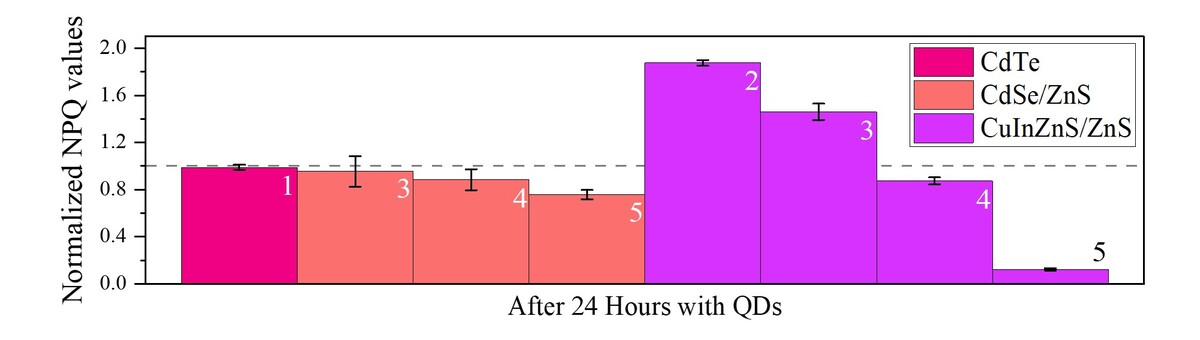
Our study showed that the effects of QDs on photosynthetic parameters of algae depend on their chemical composition. CdTe and CdSe/ZnS QDs did not cause significant changes of measured parameters compared to the control samples, suggesting minimal impact of QDs on algae. In contrast, the CuInZnS/ZnS QDs had a more pronounced effect on algae. However, NPQ parameter varied depending on the algae species: NPQ values increased after 24 hours with QDs in the Desmodesmus sp. samples compared to Scenedesmus sp. (Fig.1). For the same algae species, the effect of QDs varies depending on their growth and lighting conditions: Scenedesmus sp. grown under lower light and transferred to higher light without adaptation showed the most significant decrease in non-photochemical quenching.