Jadranka Milikić1, Ana Nastasić2, Kristina Radinović1, Katarina Rondović1, Ljiljana Damjanović-Vasilić1, Aldona Balčiūnaitė3, Vladislav Rac4, Rastko Vasilić5
1 University of Belgrade, Faculty of Physical Chemistry, Studentski trg 12-16, 11158 Belgrade, Serbia
2 Department of Nuclear and Plasma Physics, Vinča Institute of Nuclear Sciences – National Institute of the Republic of Serbia, University of Belgrade, P.O. Box 522, 11001 Belgrade, Serbia
3 Center for Physical Sciences and Technology, Saulėtekio Ave. 3, Vilnius LT-10257, Lithuania
4 Faculty of Agriculture, Department of Chemistry, University of Belgrade, Nemanjina 6, 11080 Zemun, Serbia
5 University of Belgrade, Faculty of Physics, Studentski trg 12-16, 11000 Belgrade, Serbia
Rechargeable metal-air batteries (MABs) present the most attractive electrochemical devices with charging by oxygen evolution reaction (OER) and discharging by oxygen reduction reaction (ORR). Namely, MAB performances strongly depend on the OER/ORR activity of the examined electrocatalyst. It is well known that RuO\(_{2}\)/IrO\(_{2}\) and Pt are the most active for the catalysis of OER and ORR, respectively. The high price and scarcity of them limited their electrochemical applications [1-3].
Zeolite is the most attractive porous crystalline solid with many applications in different areas because of its unique structure [3,4]. Zeolite β (BEA structural type) as a three-dimensional intersecting channel system was ionically exchanged with Ni and calcinated at high temperature to prepare Ni/β zeolite [4]. Crystalline structure and morphology of the Ni/β was done by X-ray powder diffraction analysis (XRD) and scanning electron microscopy with energy dispersive spectroscopy (SEM-EDS), respectively.
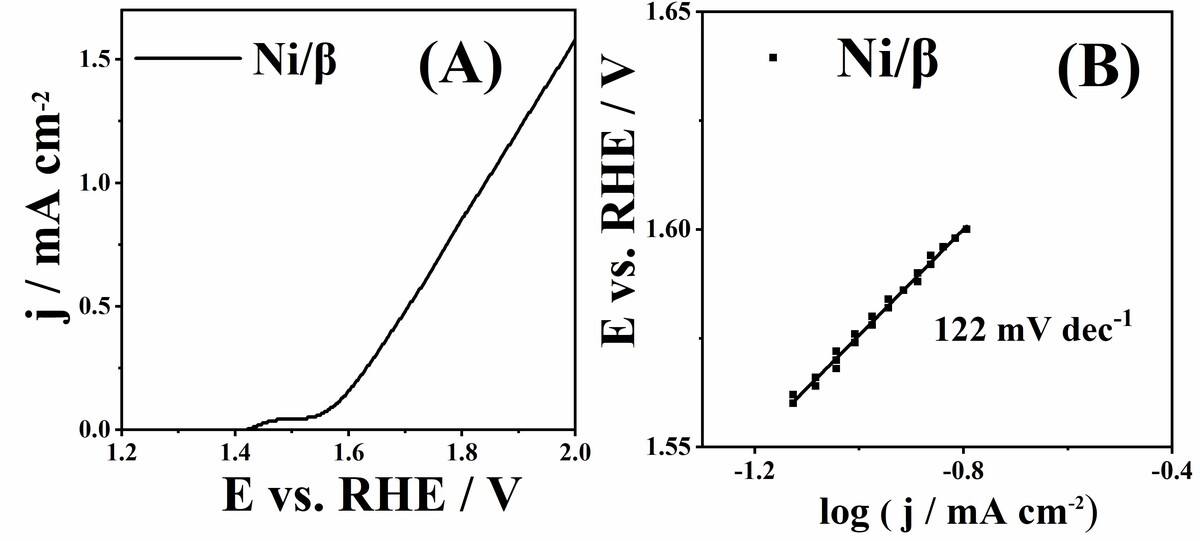
Fig. 1. OER polarization curves of Ni/β at 20 mV s−1 and 1200 rpm (A), with the corresponding Tafel plots (B).
Here we present an examination of Ni/β zeolite as an electrocatalyst for OER in alkaline media. Namely, Ni/β shows OER activity with a Tafel slope of 122 mV dec\(^{-1}\) and a current density of 1.5 mA cm\(^{-2}\) at 2 V. This behavior is comparable with other OER zeolite electrocatalysts where Ce-β cal showed 114 mV dec\(^{-1}\) [4]. Ni/β could be combined with nano-structured carbon structure to improve potential application levels in MABs.
[1] J. Milikić, A. Nastasić, M. Martins et al., Air Cathodes and Bifunctional Oxygen Electrocatalysts for Aqueous Metal–Air Batteries, Batteries 9, 1-24 (2023).
[2] J. Milikić, A. Nastasić, S. Knežević et al., Efficient nano-size ZnM/rGO (M = Ni, Cu, and Fe) electrocatalysts for oxygen electrode reactions in alkaline media, International Journal of Hydrogen Energy 97, 247-258 (2025).
[3] J. Milikić, S. Stojanović, L. Damjanović-Vasilić et al., Porous cerium-zeolite bifunctional ORR/OER electrocatalysts in alkaline media, Journal of Electroanalytical Chemistry 944, 117668 (2023).
[4] J. Milikić, S. Stojanović, L. Damjanović-Vasilić et al., Efficient bifunctional cerium-zeolite electrocatalysts for oxygen evolution and oxygen reduction reaction in alkaline media, Synthetic Metals 292, 117231 (2023)..