The development of glucose biosensors has great significance in the diagnosis and control of diabetes mellitus, which is considered a worldwide public health problem, which increases the risk of heart disease, kidney failure, blindness, postoperative and wound infections [1]. Major fundamental and nanotechnological advances opened new horizons for the application of nanomaterials and hybrid composites in bioanalytical chemistry [2]. Gold nanocompounds are usually used as connectors between the surface of an electrode and the red-ox center of glucose oxidase (GOx) [3]. The incorporation of gold nanoparticles (AuNPs) within polymers is an important aspect in the synthesis of conductive composites. Biosensors based on the GOx, AuNPs and modified by a polymeric layer have found promising applications in glucose sensing during clinical analysis and for food processing [2].
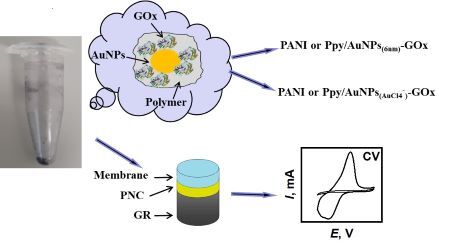
The main aim of the present study was to evaluate some characteristics of a glucose biosensor based on polyaniline (PANI) and polypyrrole (Ppy), with embedded GOx and 6 nm size AuNPs or gold-nanoclusters formed from chloroaurate ions (\(\text{AuCl}_{4}^-\)) (PANI/AuNPs\(_{(6nm)}\)-GOx, PANI/AuNPs(AuCl\(_{4}^-\))-GOx, Ppy/AuNPs\(_{(6nm)}\)-GOx and Ppy/AuNPs(AuCl\(_{4}^-\))-GOx) nanocomposites. Cyclic voltammetry (CV) was applied for the investigation of analytical characteristics of the glucose biosensor and for the evaluation of these modified electrodes in the determination of glucose in real serum samples in the presence of some interfering materials. The scheme of polymeric nanocomposites’s formation and electrochemical investigations is presented in Fig. 1. It was investigated that the relationship between log I\(_{pa}\) and log v registered from CV anodic peaks in the presence of glucose was linear and the electrochemical reaction was controlled by the diffusion. The glucose biosensor based on GR modified by Ppy/AuNPs(AuCl\(_{4}^-\))-GOx nanocomposites was characterized by high sensitivity (4.31 mA mM cm\(^{-2}\)) and good stability (the half-life period of 19 days). The GR electrode modified by Ppy/AuNPs(AuCl\(_{4}^-\))-GOx nanocomposites was suitable for the determination of glucose in the sample of human blood serum in the presence of interfering species with the recoveries in the range of 93.6–94.8%.