
As the demand for computational power continues to grow, conventional electronic computing systems face technological, economic, and environmental challenges. In response to this, with recent advances in photonics technology, optical computing emerges as a viable alternative, offering higher speeds and lower power consumption. One particularly promising approach to optical computing is the optical neural network (ONN), a hardware-based implementation of an artificial neural network (ANN) that employs different optical devices to perform the required functions [1].
In this work, as our first step toward demonstrating an ONN, we focus on developing an optical waveguide capable of unidirectional light propagation. The unidirectionality is achieved through a specially designed structure that adheres to the parity-time (PT) symmetry requirement of non-Hermitian photonics [2]. In particular, to fulfill this condition, both the real and imaginary components of the structure’s effective refractive index must be periodically modulated and phase-shifted by \(\pi/4\) relative to each other. A schematic representation of a few examples of the possible structure designs is provided in Fig. 1(a). In this work, we present the numerical investigation, encompassing the design and optimization, of such structures, as well as the exploration of different material systems that best suit our fabrication capabilities and foreseen applications.
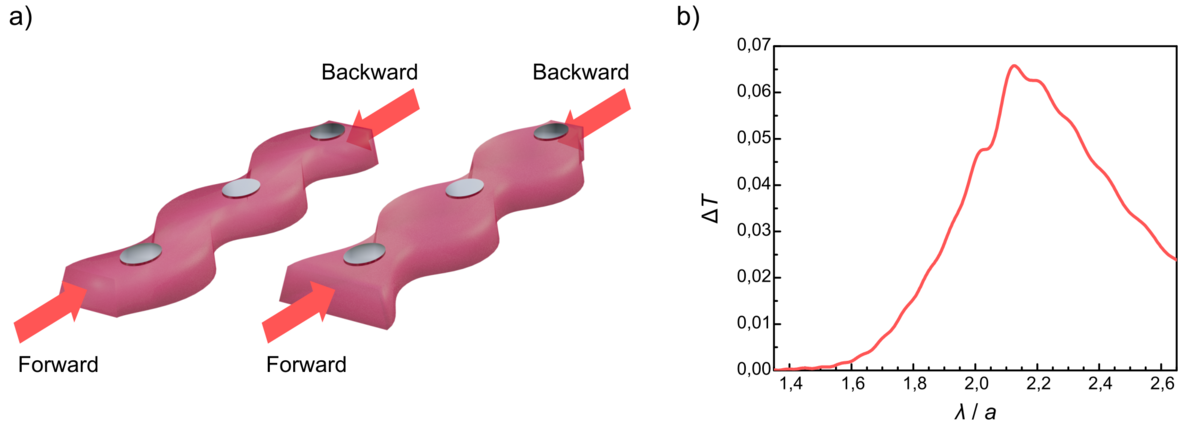
The results of an initial numerical study of such a PT-symmetric structure (left structure in Fig. 1(a)) already indicate that the difference \(\Delta T\) between the transmission of the forward- and backward-injected light is present for certain wavelength \(\lambda\) and modulation period \(a\) ratios even for a non-optimized design (see Fig. 1(b)). Consequently, with careful further optimization of the structure design and an appropriate choice of the material system, an increase in \(\Delta T\) is expected.