
Developing new theranostic tools or enhancing existing ones is exceptionally relevant, as oncological diseases remain among the most pressing global health challenges. The rapid advancements in nanochemistry over the recent decades have enabled the creation of multifunctional nanoparticles, which can serve both diagnostic and therapeutic purposes, with precise optimization of their physicochemical properties. Upconverting nanoparticles (UCNPs) are particularly noteworthy because they are excited using near-infrared (NIR) radiation, penetrating biological tissues efficiently without causing damage. By carefully tailoring their chemical composition, UCNPs can exhibit multicolor luminescence, making them highly versatile for bioimaging, photodynamic therapy, light-controlled chemotherapy, etc.
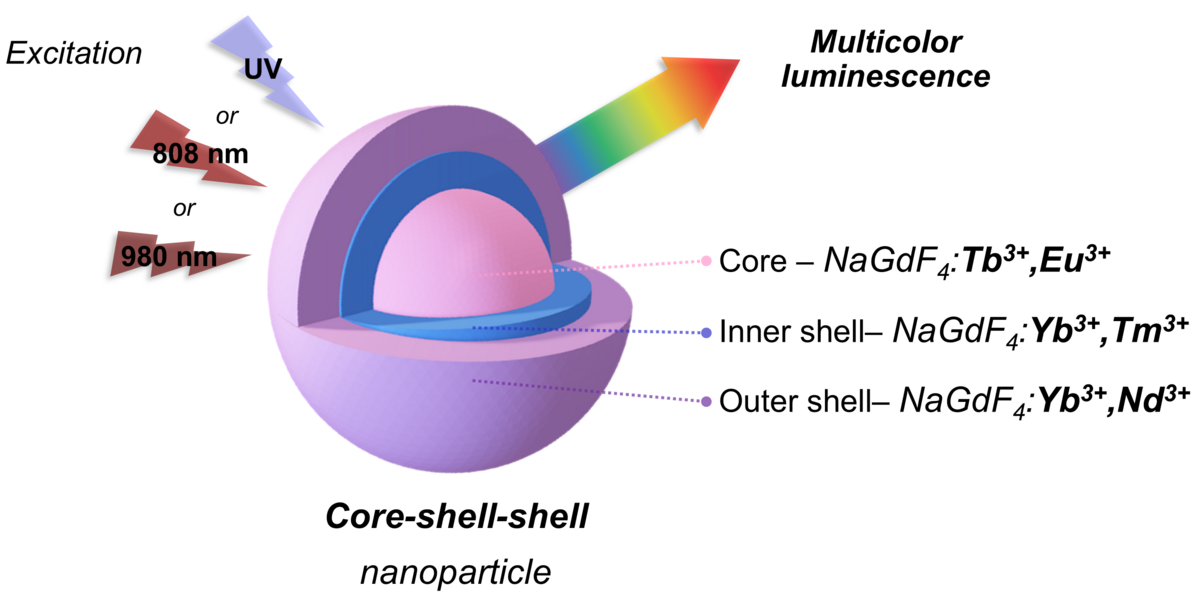
This study focuses on synthesizing and comprehensively characterizing core-shell-shell structured nanoparticles based on the NaGdF\(_{4}\) matrix. The core of these UCNPs is doped with Tb\(^{3+}\) and Eu\(^{3+}\), the inner shell with Yb\(^{3+}\) and Tm\(^{3+}\), and the outer shell with Yb\(^{3+}\) and Nd\(^{3+}\) (see Fig. 1.). A key objective is to optimize the molar ratio of Tb\(^{3+}\) and Eu\(^{3+}\) in the core, as the Tb\(^{3+}\)Eu\(^{3+}\) energy transfer directly influences the nature and intensity of luminescence in the green-to-red spectral range, which is critical for both diagnostic and therapeutic applications. By fine-tuning the chemical composition, these nanoparticles can be efficiently excited by ultraviolet and near-infrared radiation. The strategic selection of lanthanides ensures that the emission spectra span ultraviolet, visible, and near-infrared regions, highlighting the strong potential of these UCNPs for multifunctional theranostic applications.
This presentation will describe the synthesis and post-synthesis treatment of core-shell-shell structured UCNPs. Additionally, it will provide an in-depth analysis of their structural and optical properties, an evaluation of their optical and colloidal stability in aqueous and biological media, and their preliminary biocompatibility. This project has received funding from the Research Council of Lithuania (LMTLT), agreement No [S-MIP-23-5].