The COVID-19 pandemic highlighted the link between hygiene, lifestyle, and microorganism spread, highlighting the need for durable biocide-resistant coatings. Antimicrobials, such as biocides and antibiotics, are crucial for infection control, but antimicrobial resistance, identified by the WHO as a global threat, could cause 10 million deaths annually by 2050 [1]. Zinc oxide (ZnO) and 2-mercaptopyridine N-oxide sodium salt (NaPT) are approved for safe antimicrobial use. Among ZnO structures, tetrapods (ZnO-T) are unique, with four nanorods joined at a central core [2].
This study developed durable PVB/ZnO-T/NaPT nanocomposite coatings and evaluated their physical properties on quartz glass. ZnO-T sizes were controlled by centrifugation (0-5000 rpm, S\(_{0}\)-S\(_{5}\)), and NaPT concentrations ranged from 0.1% to 10%. Physical properties were evaluated using XRD, UV-Vis’s spectroscopy, and water contact angle (CA) analysis.
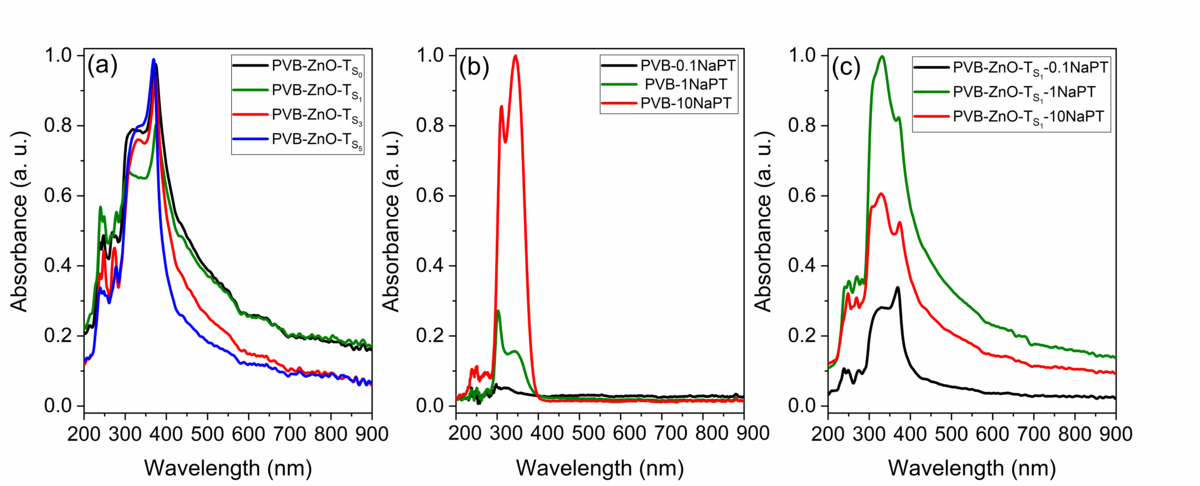
X-ray diffraction analysis of ZnO-T powders revealed a reduction in crystallite size with increasing centrifugation speed, decreasing from 42 nm at 0 rpm (S\(_{0}\)) to 30 nm at 5000 rpm (S\(_{5}\)). UV-Vis-NIR spectroscopy confirmed the successful formation of the PVB/ZnO-T/NaPT nanocomposite (see Fig. 1). The spectral properties demonstrated characteristic features of both ZnO-T and NaPT, indicative of their effective incorporation into the nanocomposite. Water contact angle (CA) analysis showed that smaller ZnO-T particle sizes enhanced the hydrophobicity of the coatings, with the CA increasing from 84° for PVB-ZnO-TS\(_{0}\) to 98° for PVB-ZnO-TS\(_{5}\). Similarly, coatings with higher NaPT concentrations exhibited improved hydrophobicity, with CA rising from 72° for PVB-0.1NaPT to 86° for PVB-10NaPT. However, when the PVB/ZnO-T/NaPT nanocomposite was formed, smaller ZnO-T sizes resulted in a decrease in CA. This research underscores the importance of optimising coating formation processes to improve the physical properties of the resulting coating surfaces.